
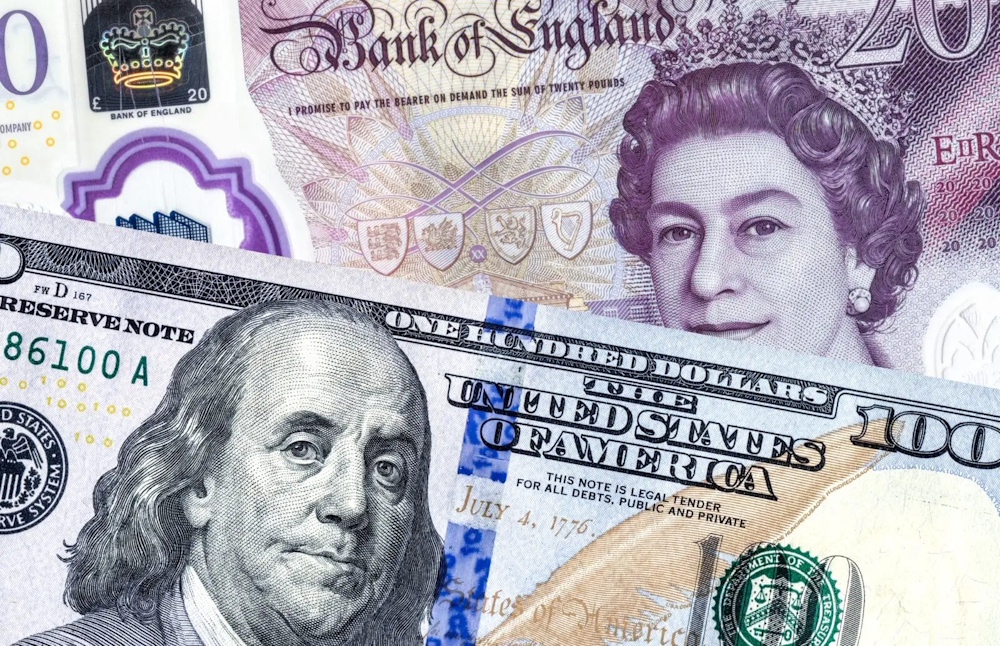
GBP/USD is currently positioned around 1.3380, having struggled to maintain momentum towards 1.3413 and subsequently retreating beneath the 200-day SMA at 1.3405. Spot has established a four-week low in the range of 1.3366–1.3370 and is currently fluctuating slightly above that level, aligning with short-term support near 1.33612 as indicated by the intraday technical analysis. The overall framework has weakened since the ascending support line established in late November was breached on 6 January; this breach transformed the prior sequence of higher lows into a definitive initial lower low. The current price is constrained by a descending trendline, facing immediate resistance at 1.34173, followed by another level at 1.34939. Provided that GBP/USD remains under 1.3400–1.3450 and below the 200-day SMA, the market indicates a transition from a corrective uptrend to a distribution phase, where rallies are being sold rather than accumulated. The US Dollar component of GBP/USD is carrying the weight. The Dollar Index is currently positioned between 99.3 and 99.5, within a rising channel on the four-hour chart. Key support levels are identified at 99.000 and 98.714, while resistance is noted at 99.745 and 100.024. The price is positioned above both short- and long-term moving averages, indicating a strong bullish momentum for the USD, while the RSI remains neutral instead of showing overbought conditions. A decisive breakthrough at 99.745 and into the 100.00 level would validate an additional phase of dollar strength; in this case, GBP/USD trading beneath 1.3360 would swiftly reveal 1.3334 and subsequently the 1.32–1.33 range. Conversely, a decisive drop in DXY below 99.000 would serve as one of the few credible triggers for a sustained squeeze back toward 1.3450–1.35 in GBP/USD; however, the current price action does not yet support that reversal.
The macroeconomic environment supports the appreciation of the dollar. Weekly US initial jobless claims decreased to 198,000, surpassing the 215,000 prediction and showing improvement from 207,000. This position comfortably resides beneath any stress threshold, affirming that the labor market continues to be tight, rather than fragile. In December, the headline CPI stands at 2.7% year-over-year, remaining unchanged from November. However, producer prices have increased to 3.0%, up from 2.8%. Additionally, regional manufacturing surveys have shifted from contraction to expansion: the New York Empire index increased to 7.7 from –3.7, while the Philadelphia Fed index rose to 12.6 from –8.8. Unemployment stands at 4.4%, surpassing the Fed’s projected rate of 4.5%. Considering the combination of robust employment figures, persistent producer inflation, and a rise in economic activity, the Federal Reserve lacks any immediate motivation to implement easing measures. Fed funds futures currently indicate a 95% likelihood of no action at the January 27–28 meeting, with expectations for approximately 44 basis points of cuts throughout the year, a decrease from nearly 60 basis points at the peak. The markets have clearly moved the initial rate cut expectation to June and are currently evaluating the likelihood of a subsequent cut occurring in December. The recent repricing serves as a significant catalyst for the USD component of GBP/USD, clarifying the trend of buying back every intraday dollar dip around DXY 99.
The political landscape is also favorable for the dollar. The recent discussions surrounding criminal charges and legal scrutiny involving Fed Chair Jerome Powell have generated considerable attention. However, the essential market takeaway remains clear: President Trump has officially confirmed that Powell will continue in his position. This alleviates the potential risk of an abrupt leadership transition at the Fed and stabilizes expectations regarding a consistent, data-informed policy trajectory. Simultaneously, a trade agreement between the US and Taiwan that emphasizes semiconductors and reduced tariffs enhances the US position in a critical industry, precisely as global demand for AI and chips is on the rise. For GBP/USD, this is significant as capital consistently gravitates towards USD assets when the policy environment appears stable and conducive to growth. Sterling faces challenges in competing on carry or growth momentum, particularly with the Federal Reserve expected to maintain elevated rates through mid-2026, coinciding with Washington’s efforts to establish growth-friendly trade agreements. The data on the UK leg of GBP/USD shows a genuine beat, though it lacks transformative impact. In November, GDP experienced a growth of 0.3% month-on-month, rebounding from a prior contraction of 0.1% and surpassing the expected growth of 0.1%. Manufacturing output has shown a rebound, suggesting that the industrial sector of the economy is not experiencing a drastic decline. However, the continued decrease in construction output highlights the ongoing unevenness of the recovery. The perspective from domestic economists continues to be one of caution: growth is characterized as “lukewarm” and “lumpy,” limited by a lack of confidence in policy. Despite the unexpected positive GDP data, markets continue to anticipate a minimum of two 25-basis point reductions by the Bank of England in 2026. The implications suggest that the rate-differential narrative continues to be unfavorable for GBP/USD: the BoE is anticipated to implement further easing compared to the Fed moving forward, rather than less. The recent short-term dynamics in the foreign exchange market indicate that Sterling has shown stronger performance compared to the Euro this week, appreciating approximately 0.18% against it. However, it has experienced a slight decline of around 0.14% against the USD. This suggests that the positive factors specific to the UK are sufficient to elevate GBP against its weaker European counterparts, but not robust enough to strengthen it against the dollar.
The upcoming catalysts for GBP/USD are concentrated in the week ahead. The UK is set to unveil labour market data, inflation figures, and retail sales, providing a comprehensive view of whether the 0.3% GDP print in November marks the beginning of a trend or merely represents a temporary fluctuation. A weaker jobs report, reduced wage growth, or an unexpected decline in CPI would confirm the prevailing outlook for several BoE rate cuts and could potentially drive GBP/USD below the support level at 1.33612, heading towards 1.33126. In the United States, housing figures hold some significance, but the primary attention is directed towards Core PCE for October and November, which is the Federal Reserve’s favored measure of inflation, along with the communications emerging from Davos and other policy discussions. If Core PCE aligns with the upward movement of the PPI, the market will have to adjust its expectations for fewer rate cuts in 2026, thereby supporting renewed strength in the USD. A significant downside surprise in US inflation would substantially weaken the dollar, allowing GBP/USD the opportunity to rise and maintain a position above 1.3450. From a technical perspective, GBP/USD is currently in harmony with the underlying fundamentals. The breach of the ascending support line from late November on January 6 signified the conclusion of the previous up-channel. Since then, the price has consistently struggled to maintain levels above the 200-day SMA at 1.3405, resulting in a pattern of lower highs and lower lows. The initial significant level is the range between 1.3360 and 1.3370, encompassing this week’s low close to 1.3366 and the short-term support area indicated on intraday charts. Subsequently, the next target is the 50-day SMA located at approximately 1.3334, followed by the previous swing high that has now become support around 1.3215 from mid-November. Analysts monitoring the broader channel identify 1.29 as the potential support level if 1.34 is breached on a closing basis. A daily and subsequently weekly close below 1.3400/1.34, along with this initial lower low, is being highlighted as a tactical shift in trend rather than a standard pullback. For the market to demonstrate a robust recovery, it must maintain levels above 1.3400, successfully reclaim the 200-day SMA, and subsequently surpass 1.34173 and 1.34939 to suggest that the bearish trend has been invalidated. Currently, those levels represent resistance zones where sellers are more inclined to re-enter the market.
The wider risk landscape is introducing complexity instead of reversing the trend. Oil prices have declined following the absence of an immediate US strike on Iran, with WTI trading in the high-50s to $60 range, while volatility has diminished after a recent geopolitical surge. Some analysts suggest that declining crude prices may, over time, exert downward pressure on the dollar, considering the changing relationship between the USD and energy markets. However, that connection is not prevailing in the near term. The current dynamics for GBP/USD are significantly influenced by robust US activity data, elevated real yields, and a decrease in Fed-cut pricing, all contributing to the dollar’s ascent despite the decline in oil prices. If geopolitical risk reignites and crude spikes sharply, the impact on GBP/USD presents a dual scenario: a significant risk-off move could bolster the USD through safe-haven demand, particularly if it leads to renewed interest in Treasuries and a tightening of global financial conditions. For Sterling, any short-term advantage from reduced energy import costs is being significantly outweighed by the narrative surrounding rates and risk premiums that favors the dollar.
Analyzing the current situation, GBP/USD is positioned beneath the 200-day SMA, constrained by a descending trendline, resting just above previously established support, and encountering a macroeconomic landscape characterized by robust US data, anticipated Fed cuts, and a BoE that is still projected to implement more aggressive easing measures. The UK GDP growth of +0.3% is decent; however, it falls short of sufficiently counterbalancing a US labor market characterized by 198K weekly claims and persistent inflation indicators that show no signs of decline. Given that DXY is maintaining a rising channel towards 100 and with Fed policy adjusted to reflect approximately 44 bps of easing this year, the likelihood leans towards additional downside for GBP/USD. From a directional standpoint, the pair is a sell, not a buy, with rallies into 1.3417–1.3494 viewed as opportunities to establish or add to shorts rather than invitations to pursue Sterling higher. While GBP/USD stays below 1.3450, the most likely trajectory initially heads toward 1.3334 and 1.3215. Should the data and Fed pricing persist in their current trend, the movement may extend toward the 1.30–1.29 channel base in the upcoming phases.