
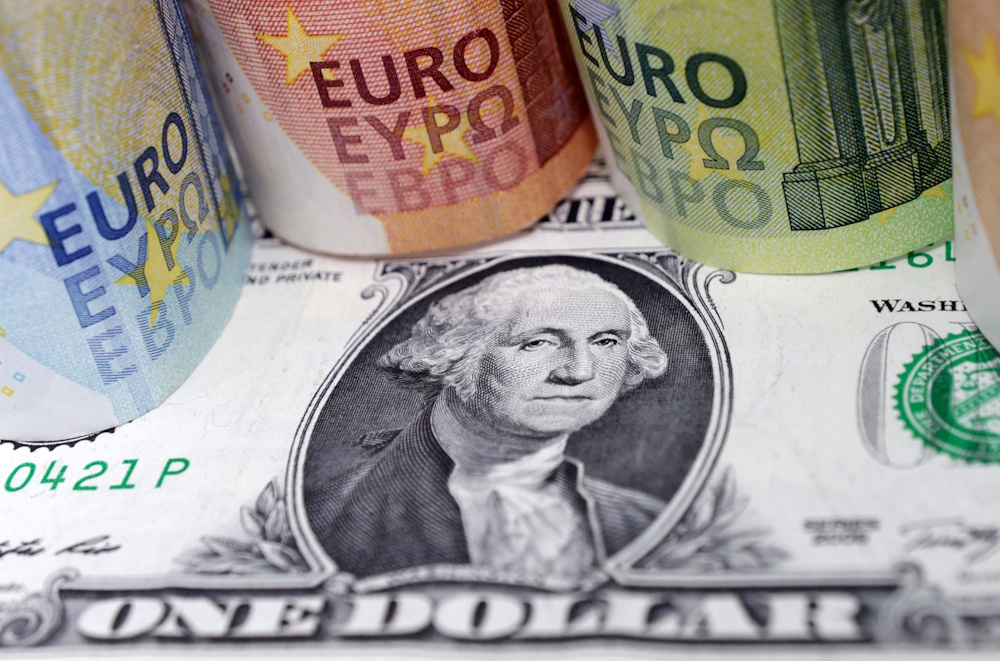
The euro experienced an upward trajectory on Thursday morning in anticipation of the European Central Bank’s decision, only to relinquish those gains within minutes following the announcement. The EUR/USD pair was observed trading near 1.1410 during the Asian trading hours, marking a continuation of gains for the second consecutive session. It reached a peak of 1.1434 in anticipation of the 14:15 release. By the time Christine Lagarde approached the podium at 15:00, the pair had declined to 1.1379. It concluded at approximately 1.1385, reflecting a decline of 0.26% for the session. The Governing Council maintained all three key rates at their current levels, aligning perfectly with the expectations of over 95% of the market. The deposit facility rate remains at 2.25%, the main refinancing rate is set at 2.40%, and the marginal lending facility stands at 2.65%. Nothing in that outcome was unexpected. The euro experienced a decline, as the unexpected developments were unlikely to originate from the interest rate trajectory. Two forces establish the prevailing dynamics from the opposing side of the duo. Brent crude surpassed $100.05 a barrel, reflecting a 6.4% increase, following claims by Iran-backed Houthi forces regarding attacks on two Saudi oil tankers in the Red Sea. West Texas Intermediate advanced more than 5% to $91.08. US Treasury yields remained at cycle highs, with the 10-year yield at 4.695% — the highest since January 2025 — the 2-year yield at 4.334%, and the 30-year yield maintaining a position above 5%. Renewed safe-haven demand for the dollar, spurred by a twelfth consecutive night of US strikes on Iranian targets, contributed significantly to the current market dynamics. The Dollar Index has been trading near 101.14, maintaining a position above its 50-day exponential moving average at approximately 100.35 and its 100-day at 99.78, indicating that the medium-term uptrend remains intact. That is not an instance of a runaway dollar. It is a dollar steadily appreciating within a range that has persisted since late June.
What renders the situation intriguing is that the euro has been appreciating despite circumstances that ought to have undermined it. Escalating conflict in the Middle East, declining equity markets, surging oil prices, and increasing US yields would typically lead to a clear demand for the dollar. Instead, EUR/USD spent the first half of this week climbing, as traders were purchasing the euro in anticipation of ECB tightening rather than divesting in response to the energy shock. That represents a positioning trade rather than a fundamental one, and the reaction on Thursday illustrates how swiftly it unwinds when the catalyst emerges. The pair currently stands fifteen pips above 1.1370 and approximately twenty pips above the critical level that delineates the trajectory for the second half: 1.1400. The structural reason for Thursday’s pause is not rooted in conviction. July is a meeting without projections. The ECB releases revised macroeconomic forecasts on a quarterly basis, specifically in March, June, September, and December. Absent new data to substantiate a shift, the threshold for taking action in July is significantly elevated compared to a forecast round. The upcoming projections are set for September 10, marking the point at which the critical decision will be determined. The statement accomplished what the rate line was unable to achieve. The Governing Council observed that the forecast for energy prices, despite significant volatility, is presently aligned with the baseline of the June Eurosystem staff projections and remains considerably elevated compared to the levels observed before the Middle East conflict. That phrasing is intentionally measured — it indicates that the energy shock has not yet surpassed the expectations set in June forecasts, while also highlighting that the baseline was significantly adjusted upward.
Context is crucial in this scenario. The ECB undertook a series of rate cuts in the initial months of 2026 as inflation approached its target level. Then the US-Iran conflict commenced in late February, leading to a surge in oil prices and a spike in European energy costs. On June 11, the Governing Council made a significant policy shift by increasing all three rates by 25 basis points, marking its first rate hike in three years. The projections accompanying that decision were stark: 2026 headline inflation revised to 3.0% from 2.6% in March, and GDP growth cut to just 0.8%. That exemplifies textbook stagflation, presenting the most challenging environment for any central bank. The instrument employed to combat inflation simultaneously acts to further decelerate growth. Since June, the data have been favourable. Euro-area headline inflation decreased to 2.8% in June, down from 3.2% in May. Wage data, activity readings, and inflation expectations have all aligned effectively. That series of prints is exactly why a prompt follow-up hike diminished in urgency, and why the Council was able to maintain its position while remaining open to future adjustments. The market had assigned a probability of over 99% to a hold prior to the announcement. Several sell-side desks characterised the meeting as a hawkish-leaning hold — maintain the current position now, take action in September. September is nearly fully priced. Beyond that, markets anticipate one to two additional increases by year-end and two more by early 2027. Which presents a real challenge for those strategising based on this meeting: if the hawkish outcome is already factored into the price, the asymmetry is unfavourable for the euro. The conference resulted in a meticulous equilibrium rather than a definitive indication. Lagarde observed that recent data indicate a degree of enhancement in economic activity, with both activity and services experiencing a partial recovery, while digital services continue to demonstrate resilience—largely driven by demand for artificial intelligence. She also stated that indicators imply economic activity continues to be modest, and that businesses and households anticipate the labour market will remain weaker than it was prior to the conflict.
Regarding inflation, she adhered to procedural language: the Council will establish monetary policy to guarantee that inflation reverts to target over the medium term, with the inflation outlook and the balance of risks serving as the primary factors influencing rate decisions. On energy, she reiterated the statement’s framing — prices are volatile but close to the June projections, with uncertainty still high — while acknowledging that the energy shock is contributing to elevated prices. What she did not do is endorse market pricing for September. That was the singular factor euro bulls required, and its absence is the reason the pair declined. The framework for Lagarde’s approach was established at the Sintra forum, where she emphasised that June’s decision was not a “insurance hike” but rather a reaction to a real inflation issue, with forecasts indicating a return to the 2% target only in late 2027, contingent upon further tightening of policy. She simultaneously declined to pre-commit, asserting unequivocally that forward guidance is not presently on the agenda. That combination — hawkish on diagnosis, non-committal on prescription — is intended to maintain flexibility. It functions effectively for a central bank. It functions poorly for a currency, as it provides traders with no basis to extend a position against. The more profound challenge that Lagarde must navigate is the disparity between market pricing and the expectations held by economists. Most economists surveyed believe that the 21-country euro zone will require significantly less tightening than what the markets currently suggest, with inflation expected to remain around 3% in the upcoming months. The reason they can be relaxed is that the long-feared second-round effects of the energy spike have not materialised. High energy costs ultimately lead to an increase in the prices of goods and services, prompting workers to seek higher wages, thereby initiating a cyclical effect. That has not occurred. If it does not occur by September 10, the two additional hikes currently priced begin to resemble one, and the euro’s sole support vanishes.
Eliminate the procedural aspects of the meeting, and the challenges facing the euro can be distilled to a singular growth figure. The ECB’s own June projections estimate that euro-area GDP growth will reach 0.8% in 2026. In the first quarter, real GDP experienced a quarter-on-quarter increase of 0.3%, after accounting for the typical volatility present in Irish data. That is an economy expanding at approximately the rate of measurement error while its central bank considers increasing rates in response to an energy shock. In contrast, the United States reported initial jobless claims for the week ending July 18 at 187,000, which was below the consensus estimate of 212,000, and a decrease from the previous week’s figure of 208,000. Regardless of other factors influencing US growth, it is clear that the labour market does not pose a limitation. In the euro area, firms and households are distinctly anticipating that employment conditions will remain weaker than they were prior to the conflict. Inflation represents the point at which the two economies align before subsequently diverging once more. Euro-area headline inflation decreased to 2.8% in June, down from 3.2% in May. While it remains above the 2% target, the trend indicates progress in the desired direction. US annual inflation reached 4.20% in May 2026, marking the highest level since April 2023, influenced by a similar energy shock, before easing to 3.5% year over year in June, contrasting with a forecast of 3.8%. Both central banks are contending with inflation levels that exceed their targets. Only one confronts it with a viable economy beneath. That asymmetry is the reason the currency market does not merely trade on rate expectations.
A central bank increasing rates in an environment of 0.8% growth is one that inherently has a tightening cycle that is limited in duration. Every basis point the ECB delivers increases the likelihood that it will need to reverse its course swiftly. Markets are pricing in expectations, which explains why the euro’s rallies in response to hawkish ECB positioning continue to falter at increasingly lower peaks. The German data present a legitimate counterpoint that merits consideration. The ZEW Economic Sentiment Index surged to 26.3 in July, up from 10.5 in June, significantly surpassing the anticipated figure of approximately 17.5. The broader euro-area ZEW reading increased to 23.4 from 9.5. Expectations are on the rise, reflecting a belief that industrial conditions and the fiscal position in Germany are set to improve. However, the current conditions component reveals the other half of the narrative: it has improved to minus 77.6 from minus 81.0. Improvement from a profoundly negative foundation remains a profoundly negative foundation, and expectations surveys have historically struggled to withstand the impact of an energy shock that continues to intensify.
