
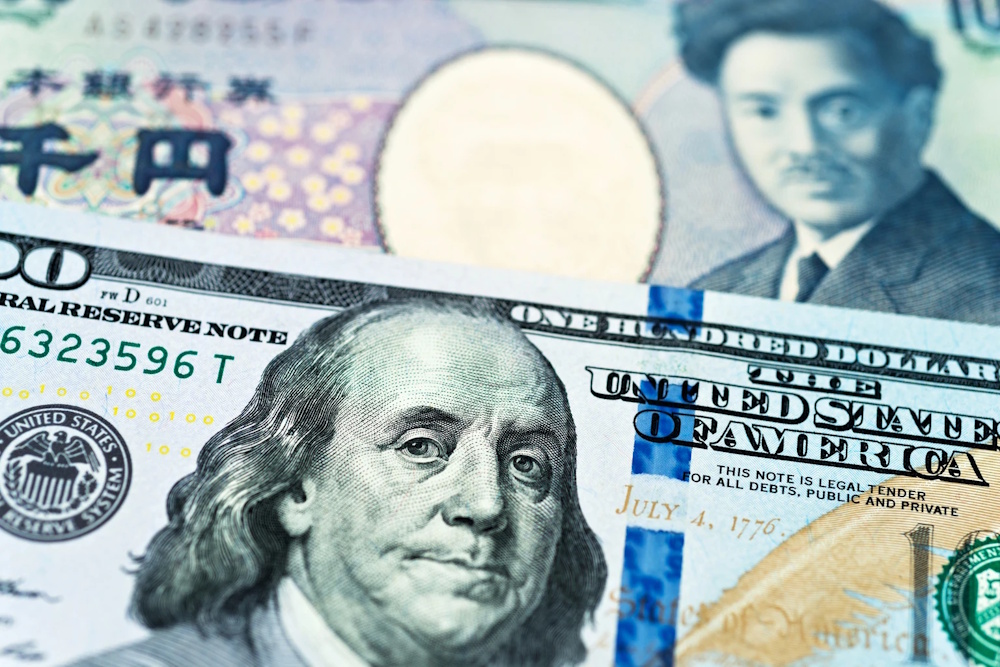
The USD/JPY exhibited a definitive bearish key reversal on Monday. It opened above Friday’s close, reached a new high at 160.45, and subsequently closed below Friday’s open after trading beneath Friday’s low. This pattern represents one of the clearest single-session reversal signals observable on a daily chart. By Tuesday, the pair was trading around 158.94-159.70, reflecting a decline of approximately 0.7%-0.8% from Monday’s peak, as the yen reacted to a simultaneous triple dose of hawkish commentary from Japan’s three most influential financial policymakers in one trading session. The overarching upward trend established from the February low of 152.25 remains technically sound — the pair is positioned significantly above its 200-day EMA, and the RSI, hovering around 59, remains in positive territory without indicating overbought conditions. However, the reversal candle, along with the policy rhetoric, has presented the first plausible near-term downside scenario since the initiation of the current uptrend. The timing presents a distinct analytical challenge: the reversal occurred on March 30, just one trading day prior to Japan’s fiscal year-end on March 31. Year-end financial flows create distortions in directional signals for yen pairs annually. Japanese corporations and institutional managers bring back overseas profits, insurers adjust their currency-hedged portfolios, and pension funds carry out year-end asset allocation changes. The key inquiry is whether Monday’s reversal indicates a true shift in direction or merely represents fiscal year-end technical fluctuations, a determination that only subsequent price movements in April can clarify with certainty.
Japan has mobilized its three leading financial figures in one trading session — a strategic move that the markets are keenly aware of and should take seriously. Atsushi Mimura, Japan’s Vice Finance Minister for International Affairs and the individual responsible for implementing FX intervention, took the initial action. He cautioned that authorities might have to implement “decisive measures” if speculative actions continue, particularly highlighting the heightened activity in both FX and crude oil markets. The term “decisive measures” refers to the precise language employed by Mimura’s predecessors as the concluding action prior to initiating intervention. This marks the inaugural instance of Mimura employing the phrase in his present capacity — a noteworthy distinction as it indicates that the escalation ladder has ascended to its second-to-last level. Finance Minister Satsuki Katayama emphasized Mimura’s message by informing G7 counterparts that Japan is observing markets with a “very high sense of urgency.” She did not confirm that Japan has received a green light from partners to intervene, but the public framing of “very high sense of urgency” at a G7 forum serves as a calculated political signal — she is creating a diplomatic record that Japan expressed its concerns to allies prior to taking unilateral action. BoJ Governor Kazuo Ueda introduced an additional layer of complexity. The connection between yen weakness and monetary policy was clearly articulated, with the bank indicating it will “closely monitor FX moves given their impact on growth and inflation,” while also leaving the possibility of rate hikes on the table.
The BoJ paper released alongside his remarks highlighted that the weakness of the yen and rising oil prices could now have a more sustained impact on underlying inflation than in the past, particularly as companies are increasingly inclined to transfer costs to consumers. This observation holds structural significance: it shifts yen weakness from being a policy-neutral factor to an active driver of inflation that the BoJ must acknowledge moving forward. The markets demonstrated a calculated response. Following Ueda’s remarks, the probability of a rate hike by the BoJ in April surged from around 68% to 82% almost instantly. The 14 percentage point repricing in just one session indicates a notable change in the interest rate differential analysis, which has been the key structural factor contributing to yen weakness since late 2025. The soft Tokyo CPI reading for March — at 1.7%, the lowest since April 2024 — introduces a notable analytical tension with the intervention narrative. The Consumer Price Index in Tokyo serves as a primary indicator for the broader inflation trends observed nationally in Japan. A 1.7% reading falls short of the BoJ’s 2% target, indicating that the central bank is not yet at the desired level for sustained rate normalization, and it does not align with the hawkish narrative suggesting three rate hikes as priced by the markets. If Tokyo CPI is softening to 1.7% while oil prices are surging and the yen is depreciating — two factors that should be pushing import prices sharply higher — it indicates that domestic demand is sufficiently weak to absorb the cost-push inflation without triggering the wage-price spiral that would warrant aggressive tightening. BoJ Governor Ueda directly acknowledged that the central bank must ensure that “rising inflation expectations do not lead to an uncontrollable acceleration in core inflation.” The framing indicates that the BoJ’s main focus is not on present inflation; rather, it is the potential for current conditions to lead to a future acceleration of inflation that could become self-perpetuating.
For USD/JPY traders, the Tokyo CPI at 1.7% offers the Bank of Japan a solid rationale to exercise patience while also keeping the verbal intervention toolkit at the ready. The central bank has the ability to caution against currency weakness and the potential for rate hikes without locking into a specific timeline for tightening. This approach maintains discomfort for speculative yen shorts while not conclusively addressing the rate differential that led to the establishment of those positions initially. The 10-year Japanese Government Bond yield at 2.35% serves as a clear indicator of the market’s reevaluation of BoJ policy. JGB yields have exhibited a “consistent upward trend” as indicated by the technical analysis of the yield curve. A 10-year yield at 2.35% significantly narrows the interest rate differential between Japan and the United States, where the 10-year Treasury is approximately 4.33%, in contrast to the levels observed when the yen was trading around 145-150. The differential has narrowed from about 290 basis points during the yen’s weakest moments to approximately 198 basis points at the present yield levels. The observed compression is significant and serves as a crucial foundation for the recovery of the yen, although it has not yet proven adequate to conclusively alter the prevailing trend.
