
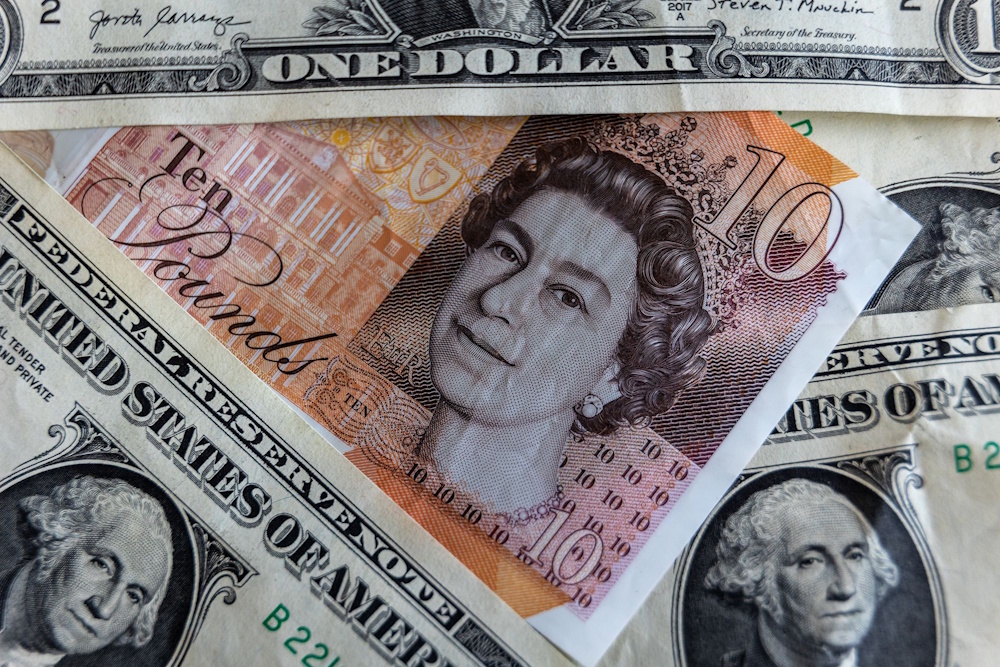
The pound is struggling in a contest where it ought to be competitive. GBP/USD slipped below 1.3350 during the American session on Thursday, moving towards the lower end of its recent range after failing to maintain a position above the 1.3400 level earlier in the day. The decline occurred as the dollar strengthened universally, driven by a robust wholesale inflation report that elevated U.S. producer prices to 6.5% year-over-year, alongside safe-haven demand prompted by President Donald Trump’s renewed threats of a significant strike against Iran. Cable commenced trading around 1.3423, reached a peak of 1.3463, and subsequently declined as the dollar regained dominance. This is the thesis: sterling has a hawkish central bank behind it, with the market pricing at least one Bank of England rate increase by year-end, yet it still cannot make headway, as two forces are overpowering that support. The first is a U.S. dollar that remains resilient, supported by elevated inflation, a hawkish Federal Reserve, and a shift towards risk aversion amid geopolitical tensions. The second issue pertains to a domestic political challenge specific to the pound, as the authority of the UK government appears notably weakened. The combination leaves cable constrained beneath its 200-day moving average around 1.3400 and drifting towards the June lows. The pattern reflects the situation observed with the euro following the ECB’s rate hike: a currency possessing authentic rate support that the dollar consistently prevents from appreciating. The pound, akin to the euro, is navigating a dollar-dominated market where the greenback exerts significant influence. Year-end forecasts that range from 1.36 to 1.40 necessitate a reversal of the dollar, yet the data presented during Thursday’s session provided no justification for such an expectation.
Thursday’s price action illustrated a case of unsuccessful recovery. GBP/USD advanced to 1.3463 during the European morning, encountering resistance at the crucial 200-day moving average around 1.3400, before reversing lower throughout the American session to fall below 1.3350. The overnight failure near 1.3400 is the level chartists are monitoring, as a sustained break above it would indicate that the pound has regained momentum from the dollar. The pair was unable to maintain it. The slide brought cable back toward the June lows, with the pair having touched 1.3325 earlier in the month and the broader range bounded below by the late-March low near 1.3182. The 52-week range spans from 1.3009 at the lower end to 1.3869 at the upper end, and over the past year, the pound has experienced a decline of approximately 1% against the dollar. This serves as a reminder that despite discussions surrounding the resilience of sterling, the pair has remained stagnant over a 12-month period. The recent upward trend from the March low has encountered a pause at the moving-average cluster. The intraday reversal encapsulated the narrative of the session. The pound’s initial strength diminished as U.S. data and Mideast headlines bolstered the dollar, which currently defines the dynamics of cable: any rally in sterling relies on a weakening dollar, yet such weakness continues to elude the market. A pair that opens at 1.3423, tags 1.3463, and closes below 1.3350 indicates a scenario where selling pressure accumulates throughout the day, with that pressure originating from the dollar side of the equation.
The prevailing influence on cable is the dollar, which remains robust due to factors unrelated to the UK. U.S. consumer inflation reached 4.2% in May, marking the highest rate in over three years. Additionally, Thursday’s wholesale figure recorded a monthly increase of 1.1% and an annual rise of 6.5%, a robust statistic that solidified the argument for the Federal Reserve to maintain a hawkish stance. The market currently incorporates a quarter-point Fed rate increase in December, and with the 10-year Treasury yield at 4.52% and the dollar index approaching 100 at a 10-week high, the greenback enjoys substantial fundamental support. The robust data performed as expected in a hawkish environment, strengthening the dollar and exerting pressure on all assets priced in relation to it. Sterling, the euro, and the broad basket all declined as the wholesale print emerged, reinforcing the higher-for-longer narrative. The dollar’s ability to maintain strength despite a three-year inflation peak illustrates the current economic dynamics effectively. In this environment, elevated inflation is advantageous for the dollar, as it compels the Federal Reserve to adopt a tightening stance rather than an easing one. Layered on top is the demand for safe-haven assets. The renewed threat to strike Iran and the second day of U.S. military action prompted a flight to safety, directing risk-off flows into the dollar as the world’s primary haven. This movement exerts direct pressure on cable, irrespective of developments in the UK. The pound finds itself in a precarious position, influenced by a dollar demand driven by both hawkish monetary policy and geopolitical anxieties. This dual support for the greenback presents a challenge that even the most assertive stance from the Bank of England cannot completely counterbalance. The dollar maintains a dominant position, and Thursday’s data has further solidified its control.
The pound’s potential support stems from a Bank of England that has adopted a hawkish stance in response to the energy-inflation pressures affecting every major central bank. The market currently anticipates at least one 25-basis-point increase in the Bank of England’s rate by the end of 2026, a significant adjustment influenced by the inflationary effects of the energy shock permeating the UK economy. In a typical economic landscape, a central bank’s shift towards tightening monetary policy is unequivocally beneficial for its currency. This action draws in capital in search of elevated yields and conveys a strong message of confidence in the ongoing battle against inflation. The issue at hand is that the hawkish inclination is being overshadowed from both directions. On the external side, the dollar’s hawkish bid and safe-haven status clearly surpass the pound’s rate support, resulting in a relative trade that continues to favour the greenback. On the domestic front, political uncertainty in the UK is counterbalancing the optimism surrounding interest rates, thereby eroding the confidence typically associated with a tightening cycle. The outcome is a hawkish BoE that has not succeeded in strengthening the pound, as the support it offers is being offset by more powerful opposing forces. This is the same dynamic that played out with the euro after the ECB hiked to 2.25%: a central bank delivering or signalling tightening, and a currency that cannot capitalise because the dollar is stronger and the domestic backdrop is shaky. The BoE’s hawkish stance establishes a support level for sterling, averting a more significant decline; however, it lacks the capacity to instigate a rally independently. For the pound to appreciate, it requires a depreciation of the dollar, rather than solely relying on an increase in the Bank of England’s interest rates. The rate support is necessary, yet it is not sufficient.
The pound experiences a domestic burden that the euro and dollar do not, and this is rooted in political factors. UK Prime Minister Keir Starmer’s authority has been significantly undermined by the resignations of junior ministers, a situation that has introduced new uncertainty into the British political landscape at a particularly inopportune time. Political instability adversely affects a currency, as it casts doubt on policy continuity, fiscal direction, and the government’s capacity to navigate the economy during challenging times. The timing exacerbates the harm. The political instability coincides with the Bank of England adopting a hawkish stance, while the energy crisis is exerting pressure on the UK economy. This situation results in the pound experiencing a decline in confidence at a time when it requires stability to leverage its rate support effectively. The resignations and the enquiries regarding the government’s position counterbalance the anticipations for Bank of England tightening, effectively neutralising what would typically serve as a tailwind. A market that might otherwise support the pound on the prospect of higher rates instead exhibits caution, mindful of the political risk. This domestic overhang explains why sterling has faced challenges in drawing buyers, even during periods when the dollar takes a breather. The pound requires external assistance, characterised by a depreciated dollar, alongside internal stability, represented by a resolved political landscape, to achieve a sustained upward trajectory. At present, it possesses neither. The political uncertainty represents a significant burden on sterling, inhibiting cable’s ability to engage fully in any widespread dollar retreat. Furthermore, it serves as a wildcard that could exacerbate the pressure should the government’s challenges intensify.
