
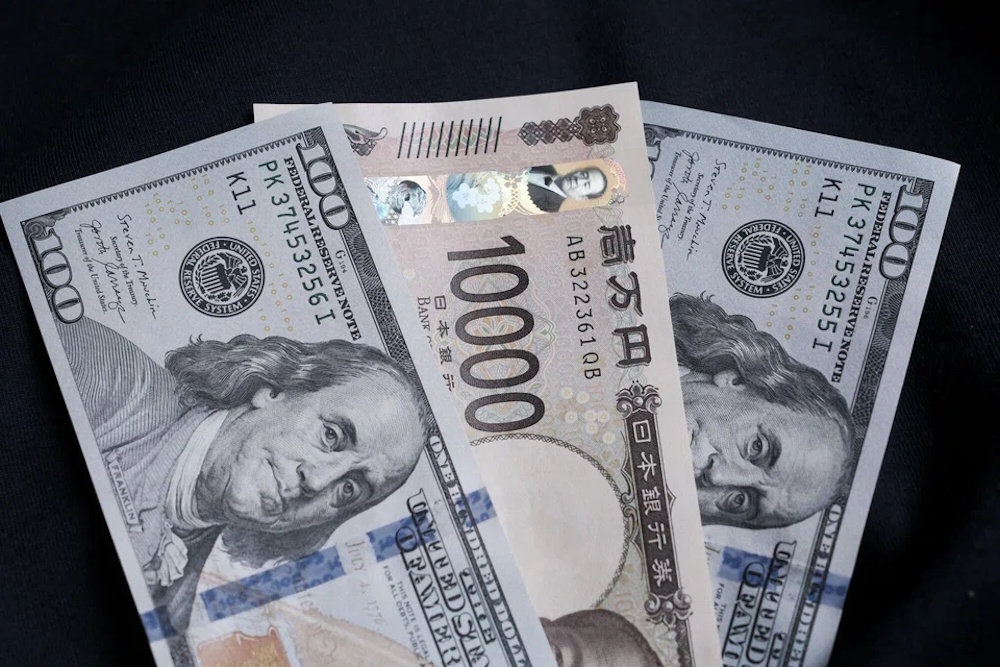
The yen entered Tuesday positioned on the line that has characterised its performance throughout the year, preparing for an unusual occurrence in the currency market: the simultaneous decisions of two major central banks within a matter of hours. On June 16, USD/JPY is positioned near 160, having peaked at 160.44 prior to a rebound in the yen, which moved back toward 160 as market participants anticipated the Bank of Japan’s policy decision. Both the BoJ and the Federal Reserve are set to conclude two-day meetings on June 17. The BoJ is widely anticipated to raise its benchmark rate by 25 basis points to 1.00% in an effort to contain inflation and support the currency, while the Fed is expected to maintain its rate in the range of 3.50% to 3.75%.It is a direct confrontation, with USD/JPY positioned at the core of the action. The setup involves a pair positioned at their point of contention. The 160 level has served as a consolidation point for USD/JPY since late March, with several attempts to break decisively above it encountering obstacles. That establishes 160 as the pivotal point for the entire forecast — a level imbued with technical significance, intervention risk from Tokyo authorities, and now a dual central-bank catalyst that will dictate the direction of its movement. The yen’s recovery toward 160 from the previous session’s losses indicates market positioning in anticipation of a BoJ hike, which should, in theory, bolster the currency. The tension lies in the fact that the yen has remained chronically weak, even in light of the BoJ’s tightening measures, primarily due to the prevailing rate gap. Even with the BoJ adjusting to 1.00%, the Fed’s range of 3.50% to 3.75% results in a differential of approximately 250 basis points favouring the dollar. This significant gap sustains the carry trade, keeping the yen near its weakest levels in decades. The yen has depreciated by 1.02% over the past month and 10.45% over the past year, despite the Bank of Japan’s efforts to normalise policy. The head-to-head showdown on June 17 serves as a critical test: a Bank of Japan hike coupled with a dovish Federal Reserve could potentially breach the 160 barrier, thereby strengthening the yen. Conversely, a Bank of Japan hike in the context of a hawkish Federal Reserve would likely maintain the disparity and result in a weaker yen. At 160, USD/JPY occupies a critical juncture, with both central banks poised to influence the outcome.
The defining paradox of USD/JPY is that the yen has continued to weaken despite the Bank of Japan’s rate hikes. The Japanese currency has experienced a decline of 1.02% in the last month and a more significant drop of 10.45% over the past year, reflecting a consistent trend of depreciation that has continued even as the Bank of Japan has taken substantial steps to shift away from its long-standing ultra-loose monetary policy. A currency whose central bank is tightening should be strengthening — yet the yen has done the opposite, and understanding why is the key to the whole forecast. The answer lies in the still-wide interest-rate gap between Japan and the US, which has largely offset the BoJ’s gradual tightening path and the repeated intervention efforts by authorities in Tokyo. Even as the BoJ raised rates, the disparity with US rates persisted at such a level that the carry trade — borrowing inexpensive yen to acquire higher-yielding dollar assets — sustained the structural pressure on the yen firmly to the downside. The BoJ’s hikes have reduced the margin slightly, yet they have not done so at a pace sufficient to alter the fundamental equations that sustain the yen’s weakness. That paradox delineates the June 17 confrontation. The BoJ’s move to 1.00% represents another step in the normalisation process; however, the yen’s 10.45% annual decline indicates that the incremental hikes by the BoJ have not sufficiently bridged the gap. The currency has been engaged in a challenging struggle — domestic tightening countered by a significantly elevated rate structure overseas and the carry flows that take advantage of it. The yen’s persistent weakness, in light of the BoJ’s tightening measures, reflects a structural reality that instills caution among bulls, even as the central bank moves towards normalisation. For the yen to genuinely strengthen, either the BoJ must accelerate its hikes or the Fed must ease meaningfully — and until the gap closes, the carry trade continues to exert pressure. The 10% annual depreciation serves as evidence that a tightening BoJ has been unable to support the yen, as the gap remains too wide. That is the benchmark the June 17 decisions must surpass.
The Japanese half of the showdown represents a historic milestone achieved at a remarkably slow pace. The Bank of Japan is widely anticipated to increase its benchmark interest rate by 25 basis points to 1.00% at the conclusion of its two-day meeting on June 17 — a level that, while still extraordinarily low by global standards, signifies a continuation of the most significant policy shift in modern Japanese monetary history. The BoJ concluded its yield curve control in March 2024, relinquished negative rates, and has been progressively increasing rates since, with the adjustment to 1.00% representing a normalisation that signifies the conclusion of decades characterised by zero and negative rate policies. The rationale for the increase lies in inflationary pressures and currency considerations. The BoJ Summary of Opinions from recent meetings indicated that a majority of policymakers are in favour of interest-rate hikes in the near term, while also cautioning about the risks associated with high inflation. Furthermore, the opinions expressed during the December meeting suggested a commitment to maintaining a tightening trajectory through 2026.The adjustment to 1.00% is intended to manage inflation and bolster the struggling yen — a currency whose decline has been contributing to imported inflation and putting pressure on Japanese households. The BoJ governs the paramount variable in any USD/JPY projection: Japanese interest rates, and it is incrementally increasing them. The historic significance is undeniable, yet the slow pace presents a challenge for the yen. After decades of ultra-loose policy, the shift toward normalisation represents a generational turning point — Japan transitioning from being the world’s anchor of cheap money to adopting a more conventional rate structure. However, the progression is measured, with increments of 25 basis points, and at 1.00%, the Bank of Japan’s rate remains a small portion of the Federal Reserve’s range of 3.50% to 3.75%.The normalisation is historic in direction but modest in magnitude, which means each hike narrows the gap only incrementally. The move to 1.00% represents a favourable shift for yen bulls — a tightening Bank of Japan serves as the underlying force that, over time, narrows the gap and fortifies the currency. However, the sluggish tempo indicates that the yen’s recovery will be a protracted and arduous journey, rather than a swift turnaround. The BoJ’s move to 1% represents a significant milestone. It serves as a reminder of the considerable distance the BoJ must traverse before the rate differential ceases to exert downward pressure on the yen.
The American half of the showdown is the Fed, and the dollar’s firmness reflects the hawkish risk in the dot plot. The FOMC concludes its two-day meeting on June 17, with the rate decision, the updated dot plot, and Chair Kevin Warsh’s debut press conference all coinciding with the BoJ’s decision on the same day. The Fed is highly likely to maintain rates at 3.50% to 3.75% — the decision itself is largely inconsequential — however, the dot plot and Warsh’s tone present significant hawkish risks that bolster the dollar relative to the yen. US inflation stands at 4.2% in May, marking the highest level since April 2023. This development has led the market to price in significant probabilities of a Federal Reserve rate hike by December, reinforcing a hawkish outlook that supports the strength of the dollar. If Wednesday’s dot plot confirms the tilt — indicating the committee is planning hikes or eliminating references to cuts — the dollar strengthens further, and USD/JPY rises back above 160, as a hawkish Fed expands the rate differential that already benefits the dollar. The greenback’s resilience through 2026, supported by persistent inflation and the Iran-war risk premium, has consistently contributed to the yen’s weakness. Warsh is the wildcard, having been sworn in on May 22 as the 17th Fed chair, thus making his debut at the podium. His perspective on whether the oil collapse alleviates the inflation trajectory will influence the dollar’s course. A hawkish Warsh strengthens the dollar and pushes USD/JPY higher toward the intervention zone; a dovish-leaning Warsh softens the dollar and gives the yen room to strengthen, helping the BoJ hike crack 160 lower. The Fed represents a dollar-positive force in this showdown, positioned directly against the BoJ’s yen-positive hike. The two decisions occurring on the same day render USD/JPY the most straightforward manifestation of the relative-hawkishness trade — the BoJ tightening to bolster the yen, while the Fed maintains a hawkish stance to support the dollar. The dollar’s firmness into the decision reflects a market that leans toward a hawkish Federal Reserve outcome, which is why the yen requires a Bank of Japan hike alongside a dovish Federal Reserve to genuinely break below 160.
Every movement in USD/JPY ultimately boils down to a singular figure: the interest-rate differential between the United States and Japan.With the Federal Reserve positioned between 3.50% and 3.75% and the Bank of Japan adjusting to 1.00%, the differential stands at approximately 250 to 275 basis points favouring the dollar. This remains substantial by the benchmarks of significant currency pairs, serving as a persistent force that maintains the yen’s weakness. The gap represents the entirety of the trade: as long as US interest rates significantly exceed those of Japan, the carry trade dynamics favour borrowing in yen to purchase dollars, thereby sustaining the yen near its lower bounds. The crucial dynamic is that the gap is shrinking for the first time in years, albeit at a slow pace. The differential has compressed from roughly 325 basis points in early 2026 toward 250 to 275 basis points, driven by the BoJ hiking while the Fed holds and is eventually expected to ease. The BoJ tightening reduces the disparity from the lower end; the eventual Fed easing would diminish it from the upper end. The pace of that compression determines whether the yen bulls or the dollar bulls are correct — a faster compression strengthens the yen, while a slower compression maintains its weakness. The challenge facing yen bulls lies in the fact that 250 basis points represents a significant disparity, one that is ample enough to uphold the carry trade and maintain the ongoing structural pressure on the yen. Even after the BoJ’s hike to 1.00%, the differential remains substantial enough that the fundamental maths hasn’t changed — the dollar continues to offer significantly higher returns than the yen, and the carry flows remain intact. That is the reason the yen has depreciated by 10.45% over the past year, even with the Bank of Japan’s tightening measures: while the gap has narrowed, it remains significant. For the yen to genuinely strengthen, the gap needs to compress meaningfully below 250 basis points, which necessitates either the BoJ to accelerate hikes or the Fed to implement cuts. The rate gap is the entire narrative, and at 250 basis points, it remains decidedly advantageous for the dollar. The June 17 decisions adjust the margin — a BoJ hike reduces it, while a hawkish Fed dot plot may expand the anticipated trajectory — yet the fundamental situation indicates that the gap persists at a width sufficient to maintain downward pressure on the yen until the compression intensifies.
