
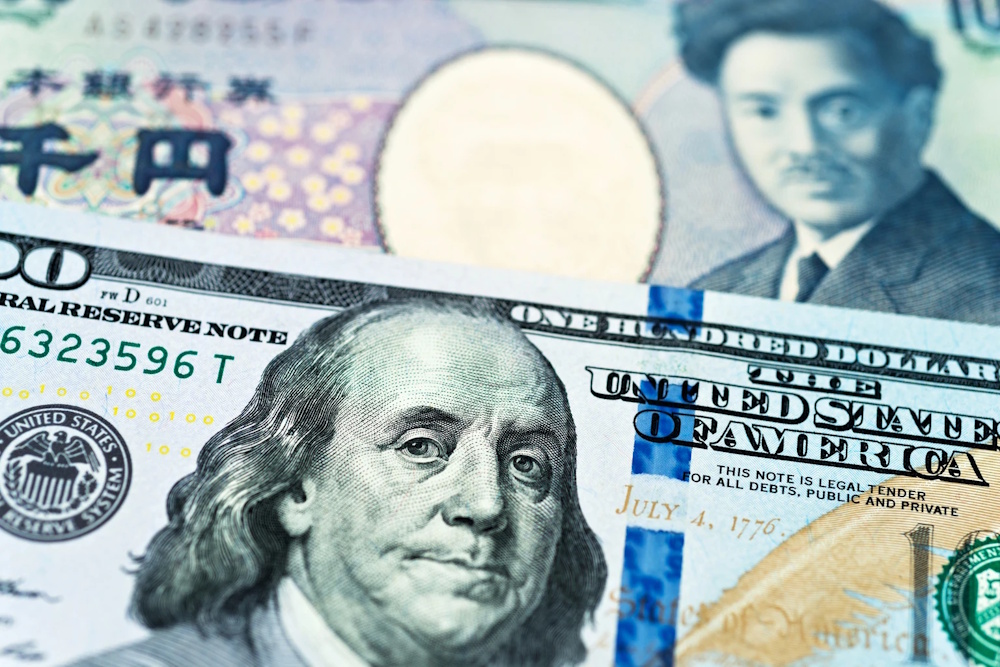
The yen is currently at a low point. USD/JPY trades around 161.7 in Friday dealing, hovering near 40-year highs and pinning the Japanese currency at its weakest level since 1986. The pair has returned to nearly the 161.95 peak, having surpassed the early-May highs where Tokyo intervened, and it continues to ascend despite ongoing verbal warnings from Japan’s Finance Ministry and unprecedented currency intervention in recent weeks. This is a market characterised by a fundamental force so overwhelming that neither official warnings nor genuine policy tightening in Japan has been able to alter its course. The thesis driving every tick is that USD/JPY remains at 40-year highs due to an interest-rate differential maintained by a hawkish Fed, which has kept it stubbornly wide. The only potential brakes on this trend are BoJ rate hikes and intervention fears; however, neither appears robust enough to reverse the trajectory while the Fed maintains its hawkish stance. This reflects the inverse trend observed in all other dollar pairs throughout the week. In the context of the hawkish Warsh Fed representing one side of a two-sided battle in EUR/USD and sterling, the dollar-yen scenario presents a stark contrast, characterised by a one-way demolition. This is primarily due to the Bank of Japan’s interest rates being significantly lower than those of the Fed, rendering even a robust tightening cycle by the BoJ insufficient to bridge the disparity. The yen continues to decline despite genuine normalisation in Japan, constrained solely by the apprehension that Tokyo may resort to intervention once more. The pair is a coiled spring near the intervention zone — a one-way grind higher until either Tokyo acts decisively or the Fed blinks, and neither looks imminent. The yen, now at its weakest point in four decades, reflects a persistent rate gap that shows no signs of narrowing.
The entire narrative surrounding the dollar-yen exchange rate can be distilled into a singular figure: the disparity between interest rates in the United States and Japan. The Federal Reserve maintains its policy rate at 3.50-3.75%, whereas the Bank of Japan, despite implementing a series of historic hikes, remains significantly lower. This results in a differential of approximately 300 basis points or more, rendering the holding of dollars considerably more advantageous than that of yen. That wide gap represents the gravitational force drawing USD/JPY toward 40-year highs, and it stands as the most critical variable in any forecast for the pair. The differential is what persistently undermines the lower-yielding yen. When one currency offers a yield of 3.75% while another provides a lesser return, capital tends to gravitate towards the higher yield. Consequently, the yen depreciates as investors borrow in yen to acquire dollar-denominated assets. The significant disparity between the Bank of Japan’s interest rates and those of leading global central banks continues to exert downward pressure on the yen, diminishing the effectiveness of verbal interventions by Japanese authorities. The mathematics are harsh yet straightforward: as long as the disparity remains this significant, the yen faces a fundamental obstacle that no degree of verbal persuasion can surmount. The differential was anticipated to compress through 2026 — the prevailing trade consensus suggested that the BoJ would raise rates while the Fed would lower them, thereby narrowing the gap and bolstering the yen. That convergence served as the cornerstone for all optimistic yen projections. The persistence of the gap, which remains notably wide, accounts for the current level of USD/JPY at 161.7, rather than the anticipated 150 or lower forecasted by numerous banks. The rate gap is the entire focus, and at this moment, it remains unchanged.
The reason the rate gap remains unbridged can be attributed directly to the Federal Reserve, particularly due to the hawkish shift initiated by the new Chair, Kevin Warsh. The convergence trade — BoJ hiking, Fed cutting, differential narrowing, yen strengthening — presupposed that the Fed would implement several rate cuts in 2026. Instead, the Fed under Warsh has indicated a contrasting stance: a hawkish dot plot, the elimination of easing-bias language, and the likelihood of rate hikes rather than cuts, with the market anticipating a potential increase by October. That hawkish pivot undermined the basis of the yen bull case. The earlier projections that had USD/JPY falling toward 150 or even 140 were predicated on the expectation of Fed easing leading to a reduction in the differential. With the Fed now leaning toward hikes, the differential that was expected to compress from approximately 325 basis points to a range of 250-275 by the fourth quarter is instead remaining wide — or even widening. The convergence trade has ceased to exist, and those who speculated against the yen, anticipating a consistently broad disparity, have been proven correct. Every dovish assumption incorporated into the bullish yen forecasts has been nullified by the Warsh Fed’s hawkish position, leading the pair to ascend to 40-year highs. The dollar’s strength, driven by hawkish signals from the Fed, is the same force propelling it against the euro and sterling. However, against the yen, the impact is magnified due to the Bank of Japan’s starting point from a significantly lower base. The Warsh Fed not only backed the dollar but also eliminated the sole catalyst that could have propelled the yen. This explains why USD/JPY continues to reach new highs while other dollar pairs remain confined within ranges.
The cruel irony of the yen’s collapse is that the Bank of Japan is indeed fulfilling its responsibilities. BoJ Governor Kazuo Ueda reaffirmed his commitment to further rate hikes in accordance with economic, inflation, and financial developments. Additionally, hawkish board member Naoki Tamura advocated for raising rates once every few months. The BoJ’s June meeting Summary of Opinions indicated that policymakers broadly supported ongoing rate hikes, referencing the advancement of underlying inflation towards the 2% target and the persistence of accommodative financial conditions. The upcoming decision regarding the Bank of Japan’s policy is scheduled for July 31. The issue at hand is that none of it holds sufficient significance. The BoJ has undertaken a significant normalisation of its monetary policy — rates increased from -0.1% in March 2024 to 0.25% by July, subsequently rising to 0.50% in January 2025, and continuing to climb thereafter — signalling the conclusion of an extended period characterised by zero and negative interest rates. However, each increase is overshadowed by a Federal Reserve maintaining a rate between 3.50% and 3.75% and indicating a potential for further increases. The markets perceive the recent hikes by the BoJ as inadequate to meaningfully narrow the interest-rate differential with other major economies, which lies at the heart of the yen’s challenges. Japan is tightening in response to a Federal Reserve that is tightening at a quicker pace, resulting in a persistent wide gap regardless of Ueda’s actions. The BoJ governs the most critical factor in any USD/JPY projection — Japanese interest rates — yet its pace of adjustment is insufficient and originates from a notably low baseline, rendering it unable to surpass the Fed’s influence. The yen’s weakness, in light of the Bank of Japan’s genuine hawkish stance, serves as the most compelling indication that it is the differential, rather than the direction of Japanese policy, that influences the pair. The Bank of Japan is increasing interest rates, yet the yen continues to depreciate regardless.
The evidence supporting additional hikes from the BoJ is accumulating in the data, and the most recent figures bolster this argument. Tokyo core inflation has accelerated for the first time in eight months, reinforcing expectations that the Bank of Japan will persist in raising interest rates. Tokyo’s inflation figures are closely monitored as a precursor to national statistics, and the recent acceleration following eight months of moderation indicates that fundamental price pressures in Japan are reemerging — precisely what the Bank of Japan requires to rationalise additional tightening. The acceleration of inflation provides Ueda and the hawkish members of the board with justification to continue raising interest rates. The BoJ has been patiently observing for consistent signs that inflation is steadily moving towards its 2% target before deciding to accelerate its pace, and the Tokyo data supports the notion that this progress is indeed tangible. Tamura’s call for hikes every few months gains credibility as inflation data shows signs of acceleration rather than a decline. For the yen, this should be supportive — rising inflation implies more Bank of Japan hikes, resulting in a narrower differential. However, the market’s response illustrates the constraints of that reasoning: the yen continued to face downward pressure despite the data, as the anticipated rate hikes are insufficient to narrow the differential, which remains too wide to alter the prevailing trend while the Federal Reserve maintains a hawkish stance. The acceleration of inflation presents a marginally positive outlook for the yen, maintaining the relevance of the July 31 BoJ decision as a potential catalyst. However, it has not sufficiently addressed the existing rate gap. The data supports the BoJ’s tightening path, and that path represents the yen’s best hope; however, it is not progressing swiftly enough to have a significant impact against a Fed at 3.75%. Tokyo inflation is accelerating, presenting a bullish case for the yen that continues to be overshadowed.
