
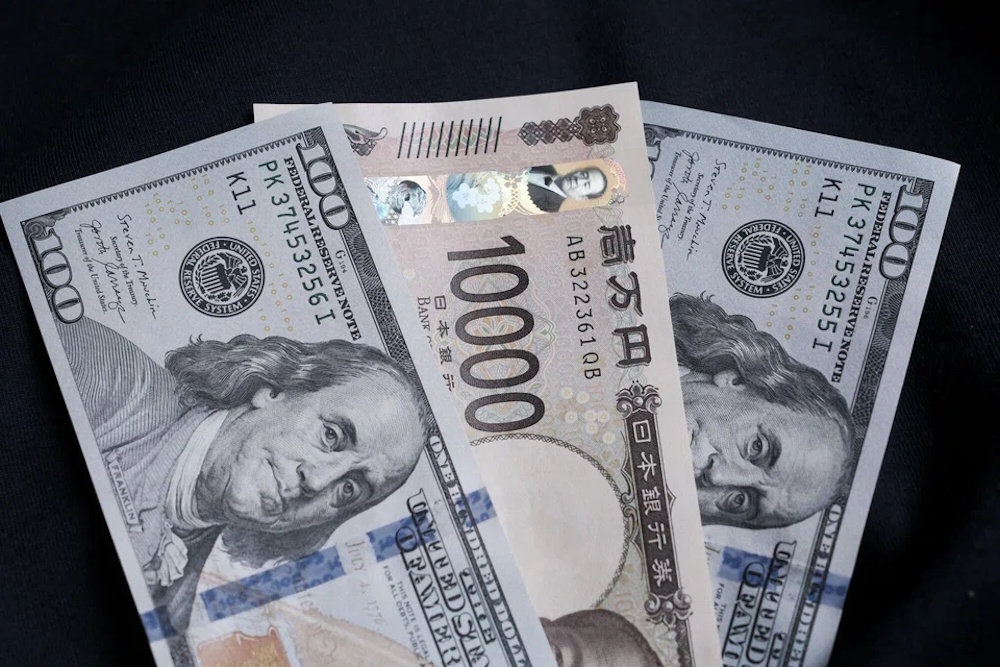
The Japanese yen is currently experiencing its lowest valuation in forty years, exacerbated by the recent developments in Iran on Wednesday. The USD/JPY pair moved closer to 162.50 as the U.S. dollar strengthened following Trump’s declaration that the Iran memorandum of understanding was “over,” with safe-haven flows prevailing in the financial markets. The pair commenced the Asian session at approximately 162.35, with the yen exhibiting strength amid intervention speculation. However, the dollar’s appeal as a safe haven, coupled with inflation concerns driven by oil prices, ultimately overshadowed the yen throughout the day. At ¥162, the yen is positioned near levels not observed since 1986, and the escalation has brought it closer to the brink. The action reveals a disquieting reality regarding the yen. In a genuine risk-off event — characterised by war headlines, a spiking VIX, and threats of fresh strikes — the yen is expected to attract a safe-haven bid, as it has historically been regarded as one of the world’s premier havens. Instead, the dollar attracted the haven bid while the yen experienced a decline. Recent U.S. military actions against Iran have propelled oil prices to a two-week peak, reigniting concerns over inflation and bolstering the appeal of the U.S. dollar as a safe-haven asset. On Wednesday, in a quest for safety, investors opted for dollars over yen, leading to an increase in USD/JPY, which approached 162.50.
The situation for the yen is unstable. Investors persist in wagering against the currency, given the lack of intervention from Japanese authorities, which maintains it near its weakest level in four decades. Finance Minister Satsuki Katayama has reiterated that officials stand ready to enter the foreign exchange market whenever necessary; however, many traders express scepticism that intervention alone would yield enduring relief. The yen finds itself ensnared by persistent fundamental frailties and the ongoing spectre of official intervention, which constrains potential gains while failing to alter the prevailing trajectory. The level’s heightened intensity is attributed to the intervention danger zone. The Ministry of Finance allocated $62 billion to defend the yen in 2024, marking the most significant intervention campaign since 1998, with the intervention threshold positioned around 155-160 on the upside. At ¥162.50, USD/JPY is above that threshold, in the zone where Tokyo has acted before and could act again. The pair is constrained: fundamental yen weakness and the carry trade propel it toward the 1986 highs, while intervention risk limits every advance. Wednesday’s developments in Iran strengthened the dollar and pushed the yen closer to its 40-year low. However, as the yen continues to rise, it approaches a threshold that could prompt action from the Ministry of Finance. The yen is exhibiting weakness, the dollar has recently strengthened, and Tokyo is closely monitoring the situation.
The most telling development in Wednesday’s price action is what it revealed about the yen’s character: it has lost its safe-haven crown to the dollar. The Japanese yen is frequently regarded as a safe-haven investment. During periods of market stress, investors have historically allocated their funds to this currency because of its reliability and stability. Consequently, turbulent times tend to bolster the yen in comparison to riskier currencies. That is the textbook. On Wednesday, the textbook did not perform as expected. Conflict intensified, leading to a preference for risk-averse assets, resulting in a depreciation of the yen and an appreciation of the dollar. The haven bid shifted towards the greenback. The reason is the rate differential. The yen’s safe-haven status was established during a period characterised by near-zero interest rates globally, where the currency’s ultra-low yield was less significant in comparison to others. Currently, the Federal Reserve stands at 3.75%, whereas the Bank of Japan is at 0.75%, resulting in a 300-basis-point disparity that renders yen holdings costly. In a risk-off scenario, investors prioritise safety while simultaneously seeking yield, and the dollar provides both advantages — it represents the most profound and liquid safe-haven market alongside a 3.75% interest rate. The yen provides a safe haven; however, with a yield of only 0.75%, it fails to remain competitive. Thus, the safe-haven flows are directed towards the dollar, while the yen continues to weaken even amid risk-off sentiment.
The oil dimension exacerbates the issue. Japan imports nearly all its energy, making a spike in oil a direct hit to its economy and trade balance. When the Iran escalation sent crude higher, it worsened Japan’s fundamental position, making the yen less attractive precisely when its haven status should have supported it. The dollar, in contrast, gains from the oil spike — the U.S. is an energy exporter, and elevated oil prices bolster the dollar via the inflation-and-rates mechanism. Thus, the identical occurrence that ought to have bolstered the yen as a safe haven ultimately undermined it due to its status as an energy importer, while simultaneously enhancing the dollar on both fronts. For the trade, the loss of the safe-haven crown represents a structural shift with tangible consequences. It indicates that the yen can no longer be depended upon to strengthen during risk-off scenarios, thereby eliminating one of the conventional pillars for the currency. USD/JPY bulls have the potential to drive the pair upward even in times of market stress, as the yen does not necessarily attract a safe-haven bid to limit the ascent. The only factor that consistently limits USD/JPY at this juncture is intervention, rather than the yen’s intrinsic safe-haven allure. That represents a diminished structural position for the yen, which accounts for the currency’s standing at a 40-year low. The yen has ceded its status to the dollar, and the price movements observed on Wednesday — characterised by yen depreciation amid heightened geopolitical tensions — serve as evidence of this shift.
The engine propelling USD/JPY upward is the carry trade, which is fuelled by the rate differential. The Fed sits at 3.75% while the BoJ sits at 0.75% — a 300-basis-point gap that renders the carry trade significantly lucrative. The mechanics are straightforward: acquire yen at an interest rate of 0.75%, invest in US Treasuries that yield approximately 4.00%, and secure the 3.25% annual spread. At scale, hedge funds manage billions in these carry positions, and the trade yields profits on any day the yen remains stable or depreciates. That persistent carry flow is the primary speculative driver propelling USD/JPY toward its 40-year peaks. The carry trade’s strength derives from its self-reinforcing characteristics. As traders borrow yen to finance the carry trade, they sell yen, leading to its depreciation. This depreciation enhances the profitability of the trade, thereby attracting additional carry positions. The result is ongoing downward pressure on the yen as long as the rate differential remains substantial. The 300-basis-point gap is sufficient to support the trade, and it serves as the fundamental reason the yen is positioned at ¥162 instead of a stronger level. The carry serves as the engine, while the wide differential acts as the fuel.
The carry does encounter a structural headwind; however, it remains viable. The BoJ is raising borrowing costs — it lifted rates to 0.75% in December 2025 — while the Fed may eventually cut, narrowing the differential from both sides. Historically, every 100 basis points of compression has been associated with a 5-8 yen movement in favour of the yen, as indicated by J.P. Morgan research. However, “narrowing” does not equate to “dead” — even the anticipated 250-275 basis point differential by the fourth quarter of 2026 remains quite lucrative in a leveraged position. The carry remains viable as long as the spread is sufficiently wide to yield a profit, and a range of 250-275 basis points comfortably meets that threshold. In the context of the trade, the carry serves as the driving force behind the upward bias of USD/JPY, even in light of the yen’s fundamental weaknesses and the associated risks of intervention. The carry flow generates a steady demand for the pair, driving it upward until an external factor disrupts the trade — this could be a sudden narrowing of the rate differential (such as Fed cuts coupled with BoJ hikes) or a risk-off scenario that prompts a carry unwind. Carry unwinds are abrupt and intense, leading to correlated declines across JPY pairs and equity markets. However, in the absence of a catalyst, the carry continues to push USD/JPY upward, with the 300-basis-point differential sustaining the trade. The carry serves as the driving force, and as long as the rate gap does not compress significantly or an unexpected event does not unwind the positions, it continues to propel the yen toward its 1986 lows.
