
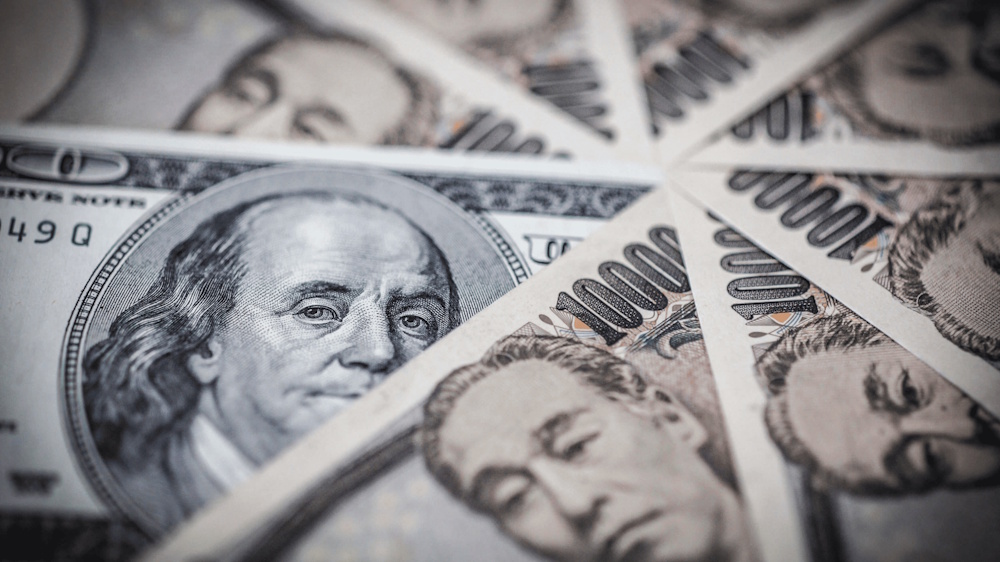
USD/JPY commenced the third quarter with a significant surge, reaching a 40-year peak as the pair exceeded 162.5 and approached new territory near 163.00, coinciding with the Japanese yen’s decline to its lowest point since December 1986. The move has placed the currency market on high alert — a yen this weak raises the spectre of intervention from Tokyo, and the market is closely monitoring every tick for indications that Japanese authorities will take action. The dollar remains robust, while the yen is struggling due to the most significant interest rate differential in decades. The magnitude of the yen’s decline is remarkable. The currency reached 161.95 before surpassing 162.5, achieving levels not observed in four decades. This movement reflects a continuous decline influenced by the ongoing interest-rate differential between Japan and the United States. USD/JPY has experienced an increase of approximately 2.1% in the last month and nearly 13% over the past year, reflecting a robust uptrend that has propelled the pair to multi-generational highs. The dollar is achieving a significant advantage over the yen. The forces driving this movement are aligned to benefit the dollar. The substantial interest-rate and real-yield differentials between Japan and the US sustain carry trades, exerting downward pressure on the yen, while the dollar benefits from the uncertainty surrounding US-Iran relations and expectations of a hawkish Federal Reserve. Recent data underscoring the robustness of the US economy — with job openings reaching a two-year peak — has strengthened anticipations that the Fed will increase rates this year, thereby enhancing the pair.
The technical picture appears optimistic yet somewhat extended. USD/JPY is currently positioned at a 40-year peak, significantly exceeding its critical moving averages, with momentum strongly favouring upward movement. However, the pair is currently positioned in overbought territory on the shorter timeframes, suggesting that the upside momentum, although robust, is becoming more susceptible to a corrective pause or a sudden reversal driven by intervention. The 162-163 zone has historically attracted selling pressure, and the pair is currently testing that resistance at multi-decade highs. The prevailing immediate concern is intervention. With the yen at a 40-year low, Japanese authorities are on high alert, and the market is observing Friday’s US holiday as a potential opportunity for Tokyo to purchase yen, given that reduced liquidity could enhance the effects of any intervention. That intervention watch looms over the market, limiting the potential for gains even as the rate differential propels the pair upward. The setup into July presents a pair at a 40-year high, influenced by the expanding rate differential and the carry trade, while the imminent risk of intervention remains a significant concern. USD/JPY near 162.5 marks the danger zone, and the resolution — the differential driving it higher or Tokyo stepping in to reverse it — will define the pair’s July. The upcoming Friday holiday, the jobs data, and the Bank of Japan are the key catalysts to monitor.
At the core of the USD/JPY’s ascent lies the interest-rate differential between the Federal Reserve and the Bank of Japan, and this gap is expanding rather than narrowing. The Fed is anticipated to implement several rate increases this year under its hawkish new chair, whereas the Bank of Japan persists in its gradual policy normalisation at a notably slow pace. The divergence between the Federal Reserve’s rapid interest rate hikes and the Bank of Japan’s gradual increases is expanding the rate gap, resulting in the currency pair reaching levels not seen in 40 years. The differential is substantial. The disparity between US and Japanese interest rates was approximately 325 basis points at the beginning of the year. Although some narrowing was anticipated, the Federal Reserve’s hawkish stance has maintained this gap. The Fed maintains its rate at 3.50% to 3.75%, with potential increases toward 4% being considered, whereas the BoJ remains significantly lower, having only gradually raised rates from historically low levels. That 300-plus basis point gap serves as a gravitational force, directing capital toward the dollar and away from the yen. The direction of the differential is paramount. Most forecasts anticipated a compression of the gap in 2026, with the BoJ expected to raise rates to approximately 1.00-1.25%, while the Fed is projected to reduce rates to around 3.50-3.75%. This would narrow the differential to roughly 250-275 basis points by the fourth quarter. Such compression would have bolstered the yen. However, the hawkish pivot of the Federal Reserve has altered the dynamic: rather than implementing cuts, the Fed is increasing rates, which maintains or further widens the differential. The anticipated compression is not occurring. The expanding disparity favours the possession of dollars.
When US rates increase in comparison to Japanese rates, capital tends to migrate towards the higher-yielding dollar, resulting in an appreciation of USD/JPY. The mechanism is direct — capital seeks returns, and the dollar provides significantly higher yields compared to the yen. With the Federal Reserve increasing rates and the Bank of Japan maintaining a slow pace, the yield differential in favour of the dollar continues to expand, resulting in the pair ascending towards and beyond 162.5. The differential also propels the carry trade. The disparity between the low cost of borrowing yen and the potential returns from investing in higher-yielding US assets underpins the carry trade that significantly influences the USD/JPY exchange rate. As long as the differential remains substantial, the carry trade remains profitable, and the yen continues to face downward pressure. The expanding disparity enhances the allure of the carry trade, attracting additional capital into this strategy and further depreciating the yen. The persistence of the differential undermines the case for a stronger yen. Numerous projections indicating yen appreciation — with targets set at 150 or 153 — have presupposed a narrowing of the interest rate differential as the Federal Reserve adopted a more accommodative stance. With the Fed hiking instead, that compression thesis is challenged, and the yen confronts a prolonged differential that sustains USD/JPY at elevated levels. The rate gap is the reason the yen cannot recover. For the forecast, the widening rate gap is the primary driver of the surge in USD/JPY. The Fed’s decision to hike rates, contrasted with the BoJ’s gradual approach, maintains a significant differential that benefits dollar holdings and stimulates the carry trade. The anticipated compression is not coming to fruition, which weakens the bullish forecasts for the yen and bolsters the pair’s ascent to 40-year highs. The rate gap serves as the driving force behind the dollar-yen rally, and its trajectory — expanding instead of contracting — explains the continued depreciation of the yen. Until the differential compresses, the yen remains under pressure.
The primary factor propelling USD/JPY upward is the hawkish pivot at the Federal Reserve under its new chair, which has altered the consensus that supported the yen-bull forecasts. Kevin Warsh assumed the role of Fed chair in May 2026, and his hawkish position — indicating several rate increases this year — altered the easing expectations that had bolstered the yen. That flip is the reason USD/JPY surged to 40-year highs. The consensus anticipated a reduction in Federal Reserve policy. Most 2026 forecasts for USD/JPY assumed the Fed would cut rates toward 3.50-3.75% while the BoJ raised rates, compressing the differential and strengthening the yen. Those forecasts — targets at 150, 153, or the high-140s — were based on the assumption of Federal Reserve easing coupled with Bank of Japan tightening. The hawkish Fed pivot undermined that premise. Instead of cutting, the Fed is hiking, which widens the differential rather than compressing it. The hawkish shift can be attributed to the robust performance of the US economy. Recent data underscores the robustness of the US economy, with job openings reaching a two-year peak and persistent inflation remaining above the 2% target. This has bolstered expectations that the Federal Reserve will implement a rate hike this year. That resilience provides the Federal Reserve with the latitude to maintain a hawkish stance and signal potential rate hikes, while the robust data continues to bolster the dollar.
The economy that remains resilient is the cornerstone of the hawkish Federal Reserve and the robust dollar. The flip reverses the yen-bull thesis. With the Fed opting for rate hikes instead of cuts, the rate differential expands rather than narrows, contradicting the expectations of yen bulls. The forecasts predicting a decline in USD/JPY toward 150 or 153 were based on an assumption of a compressing differential; however, the hawkish stance of the Fed maintains a wide differential, thereby undermining those predictions and supporting a higher exchange rate for the pair. The prevailing consensus that indicated yen strength is now confronted by a hawkish reality. The dollar’s broad strength amplifies the effect. The hawkish Fed strengthened the dollar universally — the dollar index surpassed 100, the euro declined to one-year lows, and the pound reached seven-month lows. Against the yen, which is characterised by the most significant interest rate differential and the dynamics of carry trades, the dollar’s strength is particularly evident, propelling USD/JPY to levels not seen in four decades. The hawkish Fed serves as the unifying factor across all dollar pairs, demonstrating its strongest influence against the yen. The Fed’s silence reinforced a hawkish interpretation. Warsh provided no dovish reassurance at the Sintra forum, maintaining the expectations for rate hikes and supporting the dollar’s strength. His refusal to retract the hawkish stance sustained the upward trajectory of USD/JPY, as the market adjusted to the anticipated multiple hikes he has indicated. The hawkish Federal Reserve, as evidenced by Warsh’s silence, remains the prevailing influence. For the forecast, the hawkish Fed reversing the consensus is the primary catalyst. Warsh’s shift from anticipated easing to expected rate hikes has altered the foundational assumptions of yen-bull projections, resulting in an expanded rate differential and propelling USD/JPY to levels not seen in four decades. The forecasts predicting yen strength were based on the assumption of Fed easing; however, the current hawkish reality undermines these projections. The hawkish Federal Reserve is the primary factor contributing to the continued depreciation of the yen, while Warsh’s position emerges as a critical variable to monitor. As long as the Federal Reserve signals potential interest rate increases, the yen remains under pressure, and the prevailing outlook for yen appreciation continues to face obstacles.
The prevailing speculative influence in USD/JPY is the carry trade, which serves as the catalyst propelling the yen to weaker levels. The trade is straightforward and highly lucrative: borrow yen at low interest rates, invest in higher-yielding US Treasuries, and retain the differential profit. With the rate gap wide, that difference is substantial, and the carry trade continues to attract capital, thereby exerting downward pressure on the yen. The carry trade serves as the underlying structural force driving the pair. The mathematics is persuasive. Borrow yen at approximately 0.75%, acquire US Treasuries yielding about 4.00%, and capture the 3.25% annual spread. At scale, funds manage billions in carry positions, and the trade remains profitable as long as the yen remains stable or depreciates. Such profitability attracts significant capital into the market, and each yen that is borrowed and sold to acquire dollars contributes to the further depreciation of the yen. The carry trade exhibits a self-reinforcing mechanism during upward movements. The carry trade flourishes due to the substantial differential. As long as the rate differential between Japan and the US remains substantial, the carry trade remains lucrative, and the yen continues to face downward pressure. The hawkish Fed maintaining or expanding the differential enhances the appeal of the carry trade, attracting additional capital and contributing to the depreciation of the yen. The carry trade serves as the mechanism that converts the rate gap into a depreciation of the yen. The trade encounters a structural headwind, however. In 2026, the carry encounters pressure from both directions: the BoJ is increasing the borrowing cost, while the Fed is anticipated to lower the return. That constricts the carry from both ends. However, the hawkish stance of the Federal Reserve has alleviated one aspect of that headwind — rather than implementing cuts and diminishing returns, the Fed is increasing rates, thereby maintaining the appeal of carry trades.
The anticipated compression that could have negatively impacted the carry is not occurring. The carry trade does not perish due to gradual compression. Even the anticipated 250-275 basis point differential remains advantageous in a leveraged position, ensuring that the trade does not unwind as rates converge gradually. The carry trade continues to thrive as long as the interest rate differential remains positive and the yen remains weak, which has been the case. The anticipated gradual narrowing would not have extinguished the trade, and the hawkish stance of the Fed sustains it. The carry trade’s dominance influences the pair. The billions in carry positions exert persistent selling pressure on the yen, propelling USD/JPY upward. The trade dynamics are the primary factor behind the yen’s continued depreciation, as the substantial carry flows effectively overshadow any verbal interventions that may be attempted. As long as the carry remains profitable, the yen continues to exhibit weakness. However, the carry trade encompasses an underlying risk. The trade does not unwind gradually; it unwinds violently when a sudden spike in the yen triggers margin calls, forcing liquidation cascades that result in a drop of hundreds of pips in the USD/JPY within hours. That unwind risk is the shadow looming over the carry-driven rally. For the forecast, the carry trade serves as the engine propelling the yen to a weaker position. The substantial differential renders the trade lucrative, attracting billions in capital that perpetuates the yen’s depreciation. The hawkish Fed sustains the appeal of carry by upholding returns, and the anticipated gradual compression is unlikely to undermine the trade. However, the carry entails the possibility of a sharp reversal, representing the underlying tail risk associated with the rally. The carry trade serves as the structural force driving USD/JPY to levels not seen in 40 years, with its persistence and the associated unwind risk representing the critical dynamics influencing the pair.
