
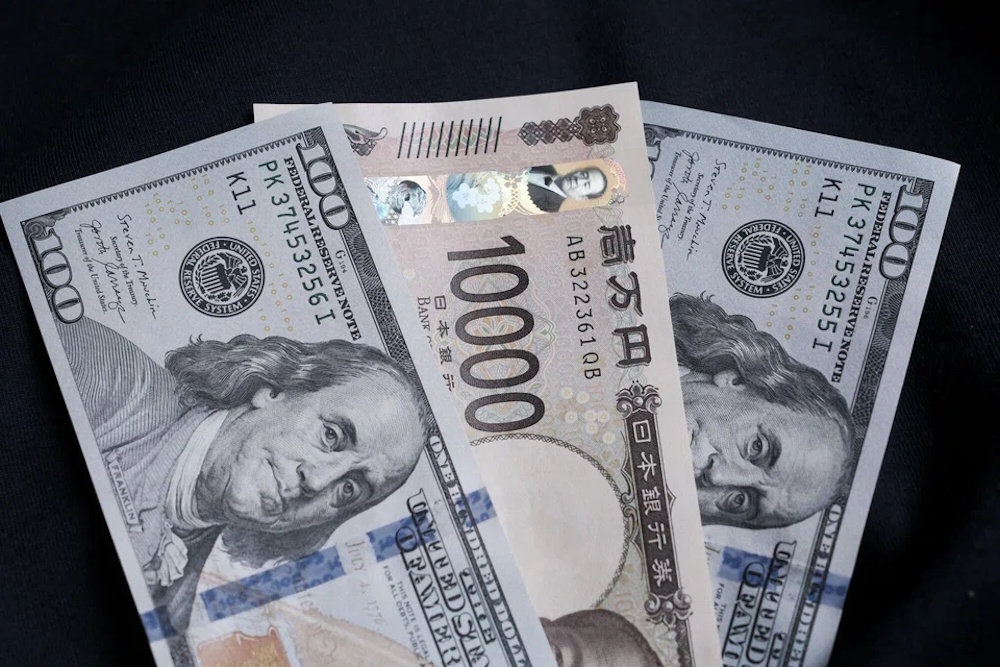
The USD/JPY pair is currently positioned just under 160.00, exhibiting the most distinct pre-event compression observed throughout the 2026 cycle. This level coincides with a 36-year peak, the 1.272 Fibonacci extension of the long-term trend originating from 2011, and the upper limit of the parallel uptrend channel that has directed price movements since 2022. The pair has increased approximately 1.7% from the recent monthly low and is now nearing the critical resistance area identified by 160.22 to 160.74 — a zone supported by the April 2024 swing high, the March high, the 2024 high-week close, and notably the 1990 swing high at 160.40 that has remained untested for 36 years. The intraday low of 157.59 days ago served as the foundation for the ongoing rally, and the breakout from the multi-week consolidation pattern observed last week validated the bullish continuation narrative that the significant rise in U.S. Treasury yields and Brent crude at $119, with an 8% weekly gain, has strengthened. The U.S. Dollar Index has rebounded to near 99.00, while U.S. bond yields have increased over 1.8% this week. The 10-year Treasury yield has climbed to 4.398%, and the 30-year Treasury yield is approaching 5%. The structural rate-differential argument that has propelled USD/JPY upward over several years remains robust and may have even intensified as the conflict in Iran influences the inflation dynamics, effectively preventing the Federal Reserve from pursuing the rate cuts that the market had anticipated for 2026. Today marks Powell’s last FOMC meeting as Chair, with the press conference scheduled for 14:30. The wording regarding inflation expectations—whether they are perceived as unanchored or contained—will be crucial in determining if USD/JPY can move past 160.74 towards the targets of 161.95 and 162.73, or if it will face a significant pullback to the support levels around 158.64 to 158.71.
The 160.40 level on USD/JPY reflects a significant historical context shaped by 36 years of Japanese monetary policy, precedents of Bank of Japan intervention, and a currency-market memory that is unfamiliar to most current traders. The initial swing high established in 1990 occurred at the height of Japan’s bubble economy downturn, a period when the Bank of Japan was deliberately strengthening the yen to address asset price inflation that had driven Tokyo real estate values to levels that notably surpassed the total worth of California. The level served as a generational ceiling for three decades, marking the threshold where the BoJ’s historical tolerance for yen weakness typically faltered. The ongoing examination of that level occurs amidst fundamentally altered macroeconomic conditions, yet it carries comparable implications for the Bank of Japan’s policy response. Governor Kazuo Ueda has indicated a steady approach to normalization since assuming office in April 2023, culminating in the BoJ’s decision to terminate negative rates in March 2024 by increasing the policy rate to a range of 0.0% to 0.1% — marking the first increase in 17 years. The central bank has shifted its approach by discontinuing yield curve control, now focusing on bond purchases instead of targeting specific yields. This change offers increased flexibility while avoiding aggressive tightening measures. The upcoming rate hike is anticipated in either July or October, contingent upon inflation and wage data. The release of the Tokyo CPI will be pivotal in determining the timing of this decision. The Ministry of Finance in Japan has consistently expressed concerns regarding the swift depreciation of the yen, yet tangible intervention has not taken place during this period. The intervention threshold is approximately at the 160.00 level, reflecting historical cycle behavior. The Ministry of Finance and the Bank of Japan have a track record of utilizing forex reserves to support the yen when speculative momentum surpasses the natural rate-differential influences. A breakout in USD/JPY exceeding 160.74 would compel the Bank of Japan to either tolerate a further depreciation of the yen towards 165.00 or deplete limited foreign exchange reserves through intervention, which would likely be ineffective due to the existing structural rate disparity with the Federal Reserve. Ueda’s assertive stance in January contributed to a significant decline in USD/JPY as market participants anticipated tighter rate differentials. However, the downturn was met with strong buying interest, leading prices to rebound to the 160.00 level. The latest phase of the BoJ’s hawkish stance has led to a notably different market reaction — prices have remained near 160.00 instead of declining sharply, indicating that the market has likely anticipated the BoJ’s policy normalization and is now concentrating on the Fed’s influence in the rate-differential context.
The interest rate differential between the United States and Japan remains the primary factor propelling USD/JPY upward, and the calculations are harsh for any bullish perspective on the yen at this point. The Federal Reserve policy rate is currently established between 3.50% and 3.75%, with the CME FedWatch tool indicating a 99.5% likelihood of maintaining this rate today, representing the third consecutive hold within this range. The Bank of Japan’s policy rate remains at 0.0% to 0.1% following the March 2024 increase, creating a 350 to 375 basis point differential that systematically attracts capital towards dollar-denominated assets while diverting it from yen holdings. The 10-year Treasury yield stands at 4.398%, while the 30-year yield approaches 5.00%. In contrast, Japanese government bond yields remain stable, even after the Bank of Japan’s decision to abandon yield curve control. This scenario presents a yield-pickup opportunity that institutional capital has been actively exploiting over several years. Carry trade flows exacerbate the underlying pressure. Utilizing the BoJ policy rate to borrow yen and investing in U.S. Treasuries, U.S. equities, or other dollar-denominated assets yields approximately 350 to 400 basis points of carry annually, excluding any potential spot-rate appreciation in the long currency. The carry-trade dynamic systematically diminishes yen demand while enhancing dollar interest throughout the USD/JPY market, irrespective of any specific macroeconomic factors. The unwinding of carry trades that has historically led to significant rallies in the yen necessitates either an unexpected hawkish stance from the Bank of Japan that narrows the rate differential, a dovish capitulation from the Federal Reserve that alters the rate-differential dynamics, or a global risk-off scenario that prompts position covering among leveraged strategies. At present, none of those three conditions are on the immediate horizon. Bond yields rising over 1.8% on the week reflects the broader repricing of Federal Reserve policy expectations as Brent crude at $119 and the inflationary pressures driven by the Iran conflict compel the Federal Reserve to adopt a hold-and-wait stance rather than the rate-cut trajectory that consensus had anticipated for the latter half of 2026. The current structural setup presents a distinctly bullish outlook for the dollar against the yen, marking the most favorable configuration seen in recent months. Any potential rally in the yen from these levels will need to navigate the challenges posed by the prevailing rate differentials to achieve a significant directional shift.
The FOMC decision today marks Jerome Powell’s last appearance as Federal Reserve Chairman before his term concludes in May. The personnel considerations surrounding this event are as significant as the policy details themselves. Kevin Warsh has successfully passed through the Senate Banking Committee with a 13-11 vote along party lines and is now moving towards a full Senate confirmation vote, where he is anticipated to assume the role of Chair following the conclusion of Powell’s term. The market has yet to fully account for the key factor influencing USD/JPY at present levels: the decision of Powell regarding his continuation on the Board of Governors after his term as Chair concludes. This choice would ensure that one of his supporters remains on the committee until 2028, limiting Trump’s capacity to appoint rate-cut proponents to the FOMC in the upcoming 18 months. Should Powell indicate a complete departure from the Board, we can expect the dollar to strengthen further, based on the belief that Warsh and other Trump appointees would create a more dovish committee. This shift could exert downward pressure on the dollar through 2027 once rate cuts commence. However, the short-term effect would likely be hawkish for USD/JPY, as the current committee will remain in place until the end of the year, and the prevailing inflation environment necessitates a hold-and-wait strategy. If Powell indicates he will remain on the Board until 2028, the immediate effect on USD/JPY is ambiguous. On one hand, continuity within the committee diminishes expectations of a dovish shift; on the other hand, it also lessens the policy uncertainty premium that is currently factored into the dollar.
The way Powell addresses the energy-induced inflation shock is more significant than the personnel issue for the current USD/JPY trading scenario. The Federal Reserve has consistently characterized the increase in inflation as driven by supply factors and temporary in nature, allowing the committee the flexibility to maintain current rates instead of implementing hikes. If Powell continues with that perspective in today’s press conference, the possibility of rate hikes remains unlikely, and USD/JPY may encounter a tactical rejection at 160.00, as the dollar’s safe-haven appeal lacks the extra support that a hawkish stance on inflation would offer. If Powell tightens the rhetoric regarding inflation expectations becoming unanchored — citing the New York Fed’s consumer survey indicating 9.4% year-ahead gas-price expectations (the highest since March 2022) and a 12.5% increase in the March CPI energy component — the market starts to price in tail-risk hikes, and USD/JPY surges past 160.74 towards 161.95 within hours. The upcoming release of the U.S. Core PCE data tomorrow morning marks a significant moment, serving as the first key inflation indicator following the Fed’s decision. This adds another critical factor to consider in the current trading environment. Powell has suggested that rate cuts could be suitable in 2026 if inflation continues to decline, yet he has pointed out that high trade uncertainty and supply-shock factors complicate the policy trajectory — precisely the type of nuanced perspective that allows the dollar to maintain its rate-differential premium over the next two to three months.
