
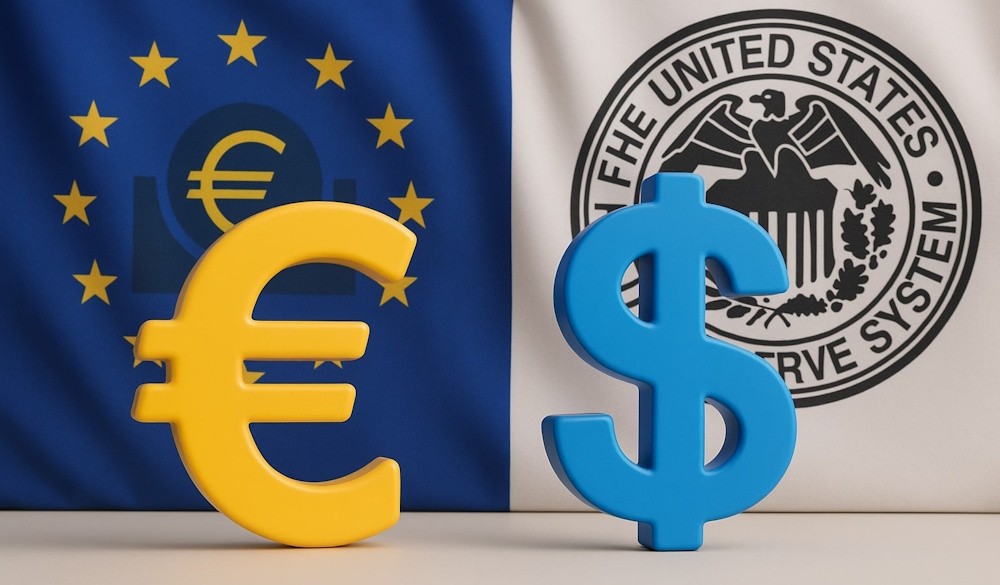
The euro extended its slide Thursday, trading near $1.1540 against the dollar and sitting at its lowest level since late March, as the fallout from the most hawkish Federal Reserve signal in years continued to lift the greenback across the board. The pair has been knocked off its perch by a meeting that flipped the rate narrative on its head, and it now finds itself testing the lower reaches of its 2026 range with the dollar trading at multi-month highs. Where EUR/USD spent much of the spring grinding sideways in the high $1.16s, it has now broken decisively lower, and the path of least resistance points down so long as the Fed’s new posture holds. The catalyst was Wednesday’s Federal Open Market Committee meeting, the first chaired by Kevin Warsh, which paired a rate hold with projections that stunned the market. With half the committee now projecting a rate hike before year-end and the inflation forecasts revised sharply higher, traders rushed to reprice the dollar higher and Treasury yields surged. The euro, already capped by a firm greenback through the spring, had little defense against a Fed that has shifted from contemplating cuts to flagging hikes, and the single currency tumbled toward $1.15 as the rate-differential story turned decisively against it.
Yet the picture is more nuanced than a simple dollar-strength story. The European Central Bank delivered its own rate hike last week and continues to lean hawkish, which under normal conditions would support the euro. The complication is that the signed US-Iran peace deal and the resulting collapse in oil prices have prompted money markets to scale back their bets on further ECB tightening, removing one of the euro’s supports just as the dollar found a fresh tailwind. EUR/USD enters the long holiday weekend — with US markets closed Friday for Juneteenth — pinned at a three-month low, caught between a newly hawkish Fed and an ECB whose tightening path the market is increasingly doubting. The hard numbers frame the shift. EUR/USD changed hands near $1.1540 on Thursday after falling to $1.15 in the wake of the Fed meeting, its weakest level since late March. The move came as the dollar strengthened broadly, with the greenback jumping nearly 1% on Wednesday and extending those gains into Thursday. The pair had held around $1.16 ahead of the Fed decision, so the break lower represents a meaningful technical and sentiment shift rather than routine noise.
The dollar’s strength is best captured by the US Dollar Index, which extended its advance for a second straight session and climbed toward the 100.6 to 100.7 region on Thursday, its highest level since May 2025. The index jumped nearly 1% on Wednesday alone and has gained well over a percent over the past four weeks, a clear signal that the hawkish Fed repricing has reignited dollar demand after a period of consolidation. Because the euro carries the largest weight in the dollar index by a wide margin, the euro’s weakness and the dollar’s strength are two sides of the same coin. Context frames the severity of the move. EUR/USD trades well below its January high near $1.2019, the peak of a broader 2026 range that has stretched from roughly $1.1435 to that high, a spread of about 5%. The pair spent much of the first half of the year oscillating in the mid-to-high $1.16s, capped by a dollar that repeatedly refused to roll over despite widespread expectations of dollar weakness. The break to a three-month low now places the euro at the lower end of that range, and the $1.1435 floor that marked the 2026 low has come back into focus. Holding above $1.1500 becomes the immediate technical question, since a clean break of that round number would expose the year’s lows and signal that the dollar’s resurgence has further to run.
The proximate cause of the euro’s slide was the Fed’s projections, which delivered a genuine shock to currency markets. The committee held its benchmark rate steady in the 3.50% to 3.75% range, the fourth consecutive hold and a decision markets had fully anticipated. The bombshell came in the dot plot. Of the eighteen officials who submitted projections, nine now see rates rising before the end of 2026, with six penciling in at least two hikes and one projecting three. As recently as March, the committee had been pointing toward cuts. The repricing in rate markets was swift and decisive. Traders moved to price a quarter-point hike into the curve by year-end, and the entire short end of the Treasury market shifted higher. For the dollar, this was straightforwardly bullish. A central bank leaning toward hikes attracts capital seeking higher yields, strengthens the currency through the interest-rate channel, and widens the gap against currencies whose central banks are closer to the end of their tightening cycles. The euro, sitting on the other side of that widening differential, bore the brunt of the adjustment.
What made the projections especially potent was the revision to the inflation outlook. The committee raised its core inflation forecasts sharply for this year and next, despite growing signs of cooling in parts of the labor market. The willingness to lean hawkish on inflation even as some employment indicators softened signaled a Fed singularly focused on price stability, a stance that supports the dollar by keeping real yields elevated. The euro had been relying on the expectation that the Fed would eventually ease, providing a tailwind for the single currency as the rate gap narrowed. That expectation evaporated on Wednesday, and EUR/USD adjusted lower in real time, with the three-month low the direct consequence of a Fed that changed the rules of the game for FX traders. The hawkish surprise carried added weight because it came at Kevin Warsh’s first meeting as chair, and it confounded the prevailing narrative about how he would steer policy. Many had assumed a Trump-backed chair would lean dovish and deliver the rate cuts the administration had pushed for. The messaging from the meeting pointed firmly in the opposite direction, and that confounding of expectations amplified the market reaction.
Warsh’s communication style reinforced the hawkish substance. He declined to submit his own dot or offer guidance on the next policy move, consistent with his long-standing criticism of forward guidance and the dot-plot framework. The post-meeting statement was deliberately terse, and it closed with a pointed commitment that the committee would deliver price stability — about as hawkish a framing as a central bank can offer without actually raising rates. He stressed that inflation has remained above the Fed’s 2% target for several years and reaffirmed the commitment to bringing it down, leaving no doubt about the committee’s priorities. The implications for the euro flow directly from this posture. A Fed chair who emphasizes price stability above all, who has stripped away the reassuring forward guidance markets had relied on, and who presides over a committee increasingly tilted toward hikes is a recipe for sustained dollar strength. The opacity around Warsh’s own views adds a layer of uncertainty, but the tone of the statement and press conference was unambiguously hawkish, and that is what currency markets traded. For EUR/USD, the message was that the dollar’s interest-rate advantage is set to persist or even widen, removing the central pillar that bulls had been counting on for a euro recovery and cementing the single currency’s break to a three-month low.
