
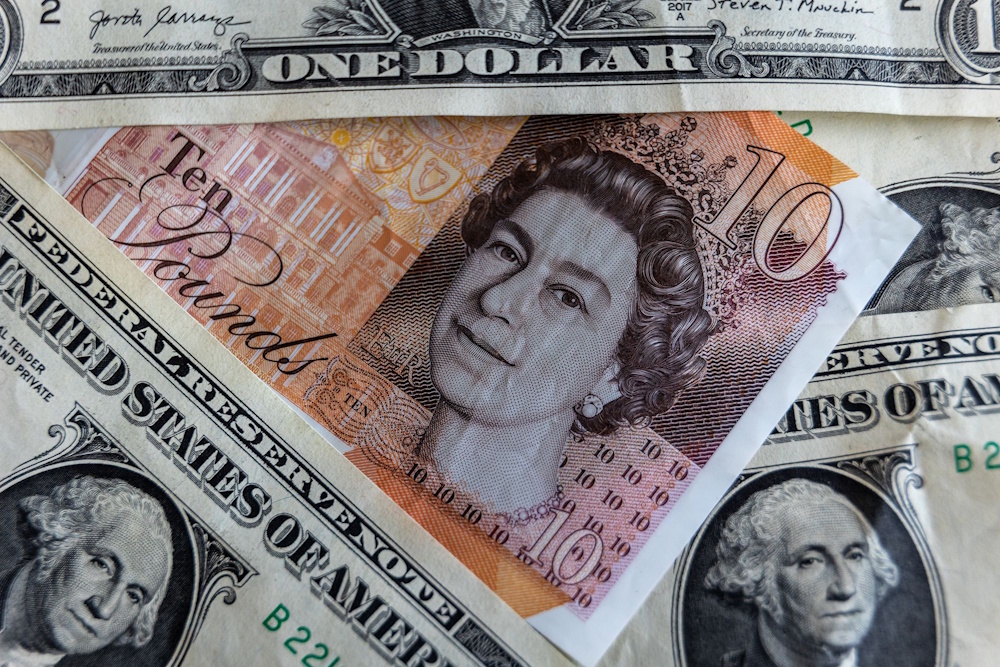
GBP/USD trades at 1.3387, reflecting an increase of 0.28%, following a Tuesday close at 1.3407, which marked a 0.44% gain that brought the pair back to mid-June levels.The pound experienced a rebound from an overnight low of 1.3369 on Monday, reaching 1.3391 prior to the release of U.S. inflation data. It has since recovered 1.68% from the low of 1.3165 recorded on June 24. Remove the dollar, and there is nearly nothing of substance present. Cable has experienced a decline of 0.05% in the past month, while showing an increase of 0.10% over the course of twelve months. That is a currency pair that has remained stagnant over the past year, despite both central banks adopting a hawkish stance, an energy shock impacting both economies, and one of the countries undergoing a change in prime minister. The 2026 range delineates the compression. The peak reached 1.3817 in late January, while the trough was 1.3165 on June 24, resulting in a 4.9% fluctuation over a span of seven months. The pair commenced July at approximately 1.336, situated beneath its 2026 average range of 1.344 to 1.345, yet above the low zone observed in June, which ranged from 1.314 to 1.317. At 1.3387, it occupies the lower segment of the range, presenting a potential upside of 4.4% to the January high and a downside risk of 1.7% to the June low. The technical condition on July 14 exhibited a remarkable neutrality, with the price positioned in close proximity to the 8-day, 21-day, 50-day, and 100-day exponential averages concurrently. Every timeframe converged on the same number, which is indicative of a market lacking a definitive perspective.
Sterling surged as subdued U.S. inflation impacted the dollar. That is the candid headline and it is also the issue, because the shift was acquired rather than generated. The pound found support as the buy side intensified its bets that the Bank of England will need to raise borrowing costs again. This hawkish shift is driven by a recent spike in energy markets, rather than any positive developments within Britain. The rate gap stands at zero. That is why this pair represents the most unadulterated expression of the dollar among the major currencies. The Bank of England’s Bank Rate currently stands at 3.75%. The Federal Reserve’s target range is established at 3.50% to 3.75%. There is no significant yield gap influencing movement in either direction, and this singular fact accounts for why the pair has fluctuated within a 4.9% range over the past seven months, while EUR/USD declined 4.91% from its January peak amid a 125-basis-point differential. When carry is neutral, price is determined by expectations rather than by the spread. That renders GBP/USD particularly responsive to fluctuations in both the dollar and sterling sentiment, while also eliminating the systematic anchor that stabilises other currency pairs. The Federal Reserve acted decisively and with significant force. The committee maintained its stance at 3.50% to 3.75% on June 17, during Warsh’s inaugural meeting, eliminated its easing bias, and released a dot plot indicating a year-end rate close to 3.8%, suggesting an increase rather than a decrease. U.S. inflation has been adjusted to 3.6% for 2026, influenced by the energy shock. That hawkish turn is what elevated the dollar throughout the second quarter and caused cable to decline from 1.3817 to 1.3165.
The Bank side is currently in the process of catching up. Markets are almost entirely anticipating two rate increases in 2026, with a September hike completely factored in. Six weeks ago, the market was engaged in a discussion regarding the potential for a rate cut by the Bank.That convergence represents the first authentic divergence cable has experienced throughout the year, and it operates to sterling’s advantage. If the Fed’s July increase is off the table at a 17% probability while the Bank delivers in September, the spread shifts from zero to plus 25 basis points in favour of sterling for the first time since the cycle began. Twenty-five basis points does not constitute a trend. Breaking a 4.9% range that has persisted for seven months is significant, especially as it occurs within a two-week timeframe.In June, the Consumer Price Index in the United States experienced a month-over-month decrease of 0.4%, contrasting with the consensus expectations that ranged from a decline of 0.1% to 0.2%. This marks the most significant single-month drop since April 2020. Annual inflation decelerated to 3.5% from 4.2% in May, contrasting with a forecast of 3.8%. Core CPI remained stable on a monthly basis, decreasing to 2.6% from the previous 2.9%. Every line missed to the downside, and the dollar sold off across the board. The response to the rates was immediate. The two-year Treasury yield decreased by 7 basis points, settling at 4.19%. The implied probability of a July hike diminished significantly from 42% to 17%. The likelihood of two rounds of tightening in 2026 has decreased from 58% to 35%. Wholesale prices confirmed it Wednesday, declining by 0.3% against a flat consensus, marking the first decrease in nearly a year. Core PPI registered at 0.2%, below the anticipated 0.3%.
Cable increased by 0.44% on Tuesday and by 0.28% on Wednesday. That represents 72 basis points of pound appreciation in response to a 25-percentage-point decline in the counterparty’s tightening odds, indicating a modest return and highlighting the constraints at play. Two factors are constraining it. First, Warsh testified before the Senate Banking Committee Wednesday, reaffirming the commitment to price stability and the 2% goal, describing the CPI report as one data point, and rejecting the framing that it represented mission accomplished. He provided no schedule for alleviation. Second, Governor Waller cautioned that the central bank might have to increase rates in the near term should inflation persist above the target level. The July increase is no longer viable. The September increase is not, and it runs at roughly 49% to 50%. Cable at 1.3387 reflects a scenario where the Federal Reserve has ceased its rate hikes, rather than one in which it embarks on a path of rate cuts. That distinction is the difference between 1.3550 and 1.28. The Bank of England maintained the Bank Rate at 3.75% on June 18, following a 7–2 vote, where two members advocated for an increase to 4%. In May, UK inflation was recorded at 2.8%, with services inflation increasing to 3.7%.The Committee will convene once more on July 30, following the Fed’s meeting, accompanied by a new Monetary Policy Report and a press conference. At this juncture, the two dissenters hold significant importance within this duo.
They articulated their rationale clearly: they are concerned that the energy shock will influence wages and price-setting. That is a mechanism argument rather than a level argument, and it implies that every firm inflation reading enhances their position rather than simply adjusting the balance. The Committee is finely balanced at 7–2, and finely balanced committees move on data rather than on debate. The market has already made its decision. Pricing now reflects nearly two complete increases in 2026, with September fully accounted for, a shift from a market that anticipated two cuts at the beginning of the year.The repricing occurred within a span of six weeks, driven by fluctuations in oil prices. The July 30 meeting represents an opportune juncture for a signal.New forecasts, a press conference, and a Monetary Policy Report must account for an energy shock that the Bank itself cautioned remained volatile and above pre-conflict levels. That is the most probable catalyst for cable to exit its current range, occurring just one day after the Fed. The complication constitutes the other half of the mandate. Energy-driven inflation maintains the possibility of an increase, while a deceleration in hiring keeps the discussion of a reduction alive.Softer GDP, labour, and services data constrain sterling’s potential for appreciation, despite the inflation figures providing some support. That is why the outlook is conditional rather than directional. The Bank is being urged to implement tighter measures in an economy that is experiencing stagnation, addressing inflation that it did not instigate.
