
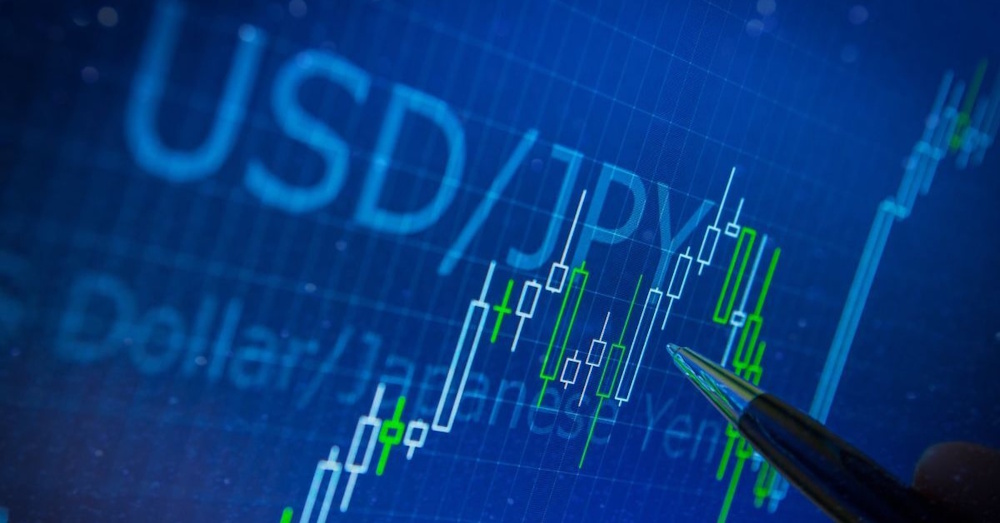
On Monday, the USD/JPY exchange rate was recorded at 163.571, reflecting a decline of 0.13% from the previous Friday’s closing value of approximately 163.78. This movement follows the pair’s recent establishment of a new forty-year low for the yen at 163.99 in the preceding session. Friday’s settle was recorded at 163.747. Over the past month, the yen has depreciated by 1.01%. Over the course of the past twelve months, it has experienced a decline of 10.17%. Those figures serve as the anchor points, and the gap between them and the record is significant: 42 pips. The yen is failing to show signs of recovery. It is consolidating near a level not observed since the mid-1980s. What distinguishes Monday is the company that the yen maintained. The dollar experienced a decline against all of its G10 counterparts as Brent crude fell by over 7% following the pause in US-Iran strikes. The dollar index softened, approaching 101.19. The EUR/USD pair opened at 1.1420. Gold surpassed $4,106. Every currency in the developed world has depreciated against the dollar. The yen experienced a movement of 21 pips. That underperformance on a broad dollar-negative day stands out as the most significant datapoint in this market. When a currency fails to appreciate during a session designed for its appreciation, the limitation is rooted in structural factors rather than sentiment. Japan ought to have emerged as the principal beneficiary of a 7% decline in crude oil prices, given its substantial dependence on energy imports. The nation’s significant reliance on oil from the Middle East has been central to its inflation challenges throughout the year. It received nearly nothing.
The journey thus far has been unyielding. The pair reached a low of 152.46 on January 27, surpassed 160 during the spring, recorded 162.83 on July 1 as a forty-year low, broke above 162.80 again mid-month, and established a new high of 163.99 last week. That represents approximately 7.5% depreciation of the yen over a six-month period, occurring in the context of a central bank that has been increasing interest rates. Sentiment in Tokyo has transitioned from a state of alarm to one of resignation. Local reporting has indicated that a sentiment is emerging in the market suggesting that the 160-yen range has become the new standard. That indicates a surrender from those most familiar with the trade, and it typically manifests later rather than sooner. Two central bank decisions are set to occur within a span of four days — the Federal Reserve on Wednesday and the Bank of Japan on Friday. One of them will determine the trading direction of this pair as we move into August, and it is likely not the Japanese currency. Japan has already implemented the direct approach on an unprecedented scale, and the outcome serves as the most significant precedent for anyone positioning themselves this week. Across April and May 2026, the Ministry of Finance deployed a record ¥11.73 trillion in foreign exchange intervention after USD/JPY breached ¥160. That figure was almost twice the size of the largest previous endeavour recorded in Japanese history. The MoF operates in multiday bursts rather than isolated single-day operations, indicating that the campaign represented sustained, coordinated dollar selling over weeks.
The pair ascended beyond the intervention level within a span of six weeks. That outcome has altered the market’s assessment. Previous interventions were effective to some extent due to the alignment with specific catalysts — a changing Federal Reserve trajectory, a risk event, and a positioning washout. This situation lacked any comparable support, and the unprecedented scale provided approximately six weeks of respite before the prevailing trend reemerged. Verbal warnings have subsequently diminished in significance. The current stance is characterised by deliberate ambiguity. Finance Minister Satsuki Katayama has declined to specify a particular defence level, stating merely that Tokyo will respond appropriately and decisively at all times, including during US holidays. She reiterated last week that authorities were prepared to take decisive action if necessary and confirmed that Tokyo remains in regular contact with Washington on foreign exchange matters. Market participants largely overlooked both. The silence regarding levels serves as a strategic approach — identifying a specific line encourages the market to challenge it. However, ambiguity only operates effectively when the threat is perceived as credible, and a $73 billion operation that spanned six weeks has undermined that credibility. The analytical consensus has reached a definitive conclusion: unilateral Japanese intervention is improbable to alter the trend as long as US-Japan rate differentials remain this substantial, and a coordinated US-Japan approach would be significantly more effective. That framing places the decision partially in the hands of Washington, creating an uncomfortable situation for Tokyo three months ahead of the US midterms.
One strategist earlier this year identified 162 as the threshold beyond which yen weakness would not be tolerated. The pair is 1.6 yen above it. That call has been surpassed, and the candid assessment is that no level has maintained its position, as no level has been upheld with anything beyond financial resources. The FOMC convenes on July 28-29, with the statement scheduled for release at 2 p.m. Eastern on Wednesday, followed by a press conference at 2:30 p.m. Consensus remains at 3.50% to 3.75%, a level sustained by unanimous vote in June, reflecting a fifth consecutive meeting without any adjustments. A quarter-point increase would elevate the range to 3.75% to 4.00% — marking the first hike in three years. The probability of a rate hike has fluctuated significantly in response to the oil market: it was at 10.7% on 15 July, increased to 34.7% by 22 July, reached 35.8% at Friday’s close, and then dropped to 30.5% on Monday following a sharp decline in crude prices. September carries a conviction of approximately 82%. For USD/JPY, this is the prevailing factor, and the rationale lies in arithmetic. The pair trades off the rate differential, which exhibits greater sensitivity to the actions of the Fed compared to those of the Bank of Japan. This is primarily due to the Fed’s adjustments occurring in 25-basis-point increments from a 3.75% base, while the BoJ is also making similar increments but from a 1.00% base, amidst a political landscape that favours stability over movement. The complication lies with the chair.Kevin Warsh’s hawkish debut in June maintained elevated US rates for an extended period, which systematically expanded the differential that enhances the appeal of the carry trade and exerted pressure on the yen. He has completely abandoned forward guidance, opted not to provide individual projections at his initial meeting, and publicly asserted in early July that prices are excessively high.There is no Summary of Economic Projections and no dot plot this week; both will return on September 15-16. Markets receive a statement, a vote tally, and a press conference.
Historically, a hawkish Federal Reserve of precisely this nature has been the catalyst for Japanese intervention, as it exacerbates the differential that Tokyo is attempting to combat. The committee exhibits a division of opinion — among the eighteen policymakers who submitted projections for June, an equal number supported maintaining or reducing rates, while the other half endorsed an increase before the year’s conclusion. The sequencing risk represents a significant pitfall. US second-quarter GDP and June PCE are scheduled for release at 8:30 a.m. Eastern on Thursday, occurring less than a day after the decision. First-quarter growth was adjusted upward to an annualised rate of 2.1%. A hawkish Wednesday statement that drives USD/JPY toward 164 may be countered Thursday morning by a cooler core PCE, only to be reversed once more by the Bank of Japan on Friday.Any Wednesday move should be regarded as provisional. The Bank of Japan’s Policy Board convenes on July 30-31, with the statement expected to be released around midday Tokyo time, followed by the governor’s press conference at 3:30 p.m. JST. The policy rate stands at 1.00%. That level was established on June 16, when the Board increased by 25 basis points from a 0.75% plateau that had persisted since December 2025, elevating the benchmark to its highest point since 1995. The vote was 7-1, with Asada Toichiro opting to hold. The direction of dissent is noteworthy: earlier in the year, the dissents were orientated differently, with Takata Hajime and subsequently two colleagues advocating for an earlier increase. A board that has transitioned from hawkish dissent to dovish dissent within a span of six months indicates a genuine uncertainty regarding the next move.
The market’s response to June’s hike illustrates the limited impact of a 25-basis-point adjustment in this context. The Nikkei 225 experienced an increase of 0.46% following the decision.The yen experienced a slight appreciation, reaching 160.22. The 10-year JGB yield increased by three basis points to 2.615%.Three weeks later, the pair was at 162.83. One strategist characterised the increase as little more than a temporary fix for the currency’s deeper issues. The statement itself articulated the crude-oil issue in straightforward terms. The Bank observed that Japanese consumer inflation has been maintained below 2% due to government initiatives aimed at alleviating the household impact of escalating energy costs. However, the transmission of rising crude prices in business-to-business transactions has been advancing at a notable rate and may extend to consumer prices across a diverse array of goods. That is a central bank indicating its anticipation of imported inflation manifesting with a delay. On the balance sheet, the Bank is persistently decreasing government bond purchases by ¥200 billion each calendar quarter prior to ceasing the taper and sustaining monthly JGB purchases of ¥2 trillion starting in April 2027. April’s meeting resulted in a hawkish hold accompanied by an increased inflation forecast, which one strategist interpreted as being as much about currency defence as it is about controlling inflation. Consensus for Friday leans toward a hold, which would render the press conference the focal point of the event.
