
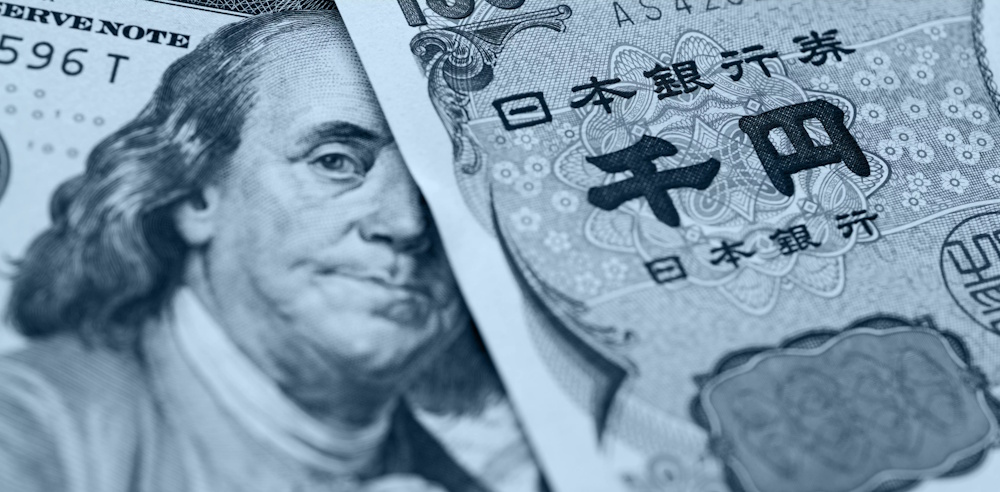
The dollar is currently valued at 155.40 against the yen, reflecting a decrease of 2.07% for the day and marking a continuation of its decline for a second consecutive session. That represents a four-yen movement within a single trading day from a previous close around 158.68, bringing the pair to its lowest point since August 3. The trajectory was tumultuous, gaining momentum with each session. During Asian hours, the USD/JPY experienced a decline of 0.6%, settling at 157.81, as the yen appreciated by as much as 0.5%. This movement followed a notable 1.2% increase during New York trading on Wednesday. It subsequently breached 157.99 decisively, advanced to 156.15 by mid-morning, and continued its descent into the 155 range. The driver is not the Federal Reserve, and that is what renders today noteworthy. Brent crude reached an intraday peak of approximately $97.62, marking its highest point in six weeks, driven by renewed hostilities between the U.S. and Iran, alongside an increasing acknowledgement that disrupted regional energy flows may continue through 2027. Brent exceeding $97, coupled with a war persisting beyond this year, typically constitutes a strong dollar-supportive scenario through the mechanisms of inflation and interest rates. Instead, the dollar index declined to 99.00 from Wednesday’s 99.86, and USD/JPY experienced a significant drop. Oil continues to pose a significant risk to global inflation. Japan is establishing the trajectory of its currency.
The impetus originated from two officials at the Bank of Japan. Board member Hajime Takata stated Wednesday that a 25-basis-point hike is not necessarily predetermined and that consecutive increases remain a possibility, contending that rates should adjust swiftly in response to inflation rather than adhering to a fixed semiannual schedule. Governor Kazuo Ueda stated on Tuesday that the board will evaluate the possibility of a rate increase at each meeting, including the upcoming session on September 17-18. Markets have reacted in a manner consistent with expectations. Approximately 90% of the pricing for a 25-basis-point hike at the beginning of the week has transitioned to being nearly fully priced in, with a minor probability now attributed to a 50-basis-point increase. On the American side, Federal Reserve Governor Christopher Waller reduced the odds of a September rate hike from 63% to around 48%. Two central banks, two days apart, taking divergent paths. The thesis for this forecast posits that the yen rally is now fundamentally propelled by interest rates rather than government interventions in the dollar market. This distinction is crucial, as it differentiates between a sustainable movement and one that is likely to be reversed. The level that tests it is ¥155.20.
The single most informative feature of today’s session is what did not occur. Brent crude achieved an intraday peak near $97.62, continuing a rally that has propelled crude prices over 7% this week, positioning the benchmark at its highest level in six weeks. West Texas Intermediate is priced at $91.98. Kuwait’s armed forces stated on Thursday that the nation is experiencing persistent Iranian aggression, as air defences intercepted missiles and drones. The United States and Iran have engaged in reciprocal strikes for the first time since late July. Every element of that should be favourable for the dollar. Increased crude oil prices contribute to American headline inflation, heightening the likelihood of Federal Reserve tightening, elevating Treasury yields, and fostering demand for safe-haven assets. That is exactly the sequence that propelled the dollar index from a three-month low of 98.8 on August 21 to 99.86 on Wednesday, as the pricing for a September hike escalated from 36% to 68%. Today it experienced a significant decline. The dollar is experiencing a general decline as Brent reaches a six-week peak. The explanation is that the narrative surrounding the conflict is transitioning from a tactical focus to a structural one. Initial stages of the conflict were characterised by pressing enquiries regarding every attack, every counteraction, and any possible disruption in Hormuz. Markets are currently evaluating the possibility that disrupted regional energy flows may continue until 2027. Commentary has increasingly shifted toward this extended timeframe, with expectations suggesting that the restoration of energy flows from the Middle East will be postponed until early next year.
A prolonged conflict alters the central bank that is most affected by oil price pressures. Japan relies heavily on the Middle East for its energy imports, with petrol prices reaching unprecedented heights in mid-March before the intervention of government subsidies provided some relief. Sustained $97 Brent represents a significantly greater inflationary impact for Japan compared to a net energy exporter, compelling the Bank of Japan to respond more directly than the Federal Reserve is required to do. Ueda designated it. Among the key factors he highlighted for examination at the September meeting were upward price pressures stemming from the Middle East conflict, strong demand associated with AI, and the inflationary impact of a depreciating yen. Oil has become a factor that strengthens the yen. The inversion represents the most critical aspect to comprehend regarding this pair for the remainder of the year. The particular remark that disrupted the pair warrants careful examination, as it altered the distribution instead of the base case. Board member Hajime Takata stated on Wednesday that the central bank ought to embrace a more adaptable strategy regarding future rate increases, indicating that a 25-basis-point hike is not definitively predetermined, and that consecutive increases remain a viable option. He contended that rates ought to increase swiftly in reaction to inflationary pressures instead of adhering to a regular semiannual timetable, particularly to mitigate the risk of an inflation overshoot.
He articulated the reasoning in a structured manner: 2026 signifies a shift in the economic regime, propelled by global growth and investment associated with artificial intelligence. Prior to those comments, markets assigned approximately a 90% probability to a 25-basis-point adjustment on September 18, with virtually no expectation for further changes thereafter. Subsequent to that, a minor likelihood of a 50-basis-point increase emerged within the curve, and the prospect of successive hikes became a tangible consideration. That represents a shift in the tail, rather than in the median, and it is the tails that drive currency movements. A fully priced 25-basis-point hike is already reflected in USD/JPY. A 50-basis-point hike, or an indication that October and December are also active, is not. The policy context lends credibility to the situation. The Bank of Japan raised rates to a 31-year high of 1% in June, based on the assessment that Japan was on the verge of sustainably achieving its 2% inflation target. The rate was maintained in July, with indications of potential future adjustments. Consumer inflation has surpassed the 2% target for a prolonged period, and real borrowing costs continue to be significantly negative despite the increase in June. A central bank with a 1% policy rate, inflation above 2%, a currency near 40-year lows, and $97 crude presents a compelling argument for accelerating its actions beyond the guidance previously indicated. Takata is a recognised hawk, which somewhat diminishes the weight of his remarks. Ueda’s remarks aligned with this sentiment, and collectively, they dispelled the notion that the Bank would adhere to a consistent timetable for its actions. The two-year JGB yield, which is the maturity most sensitive to policy changes, rose to 1.830% on Wednesday, marking its highest level since 1995.
