
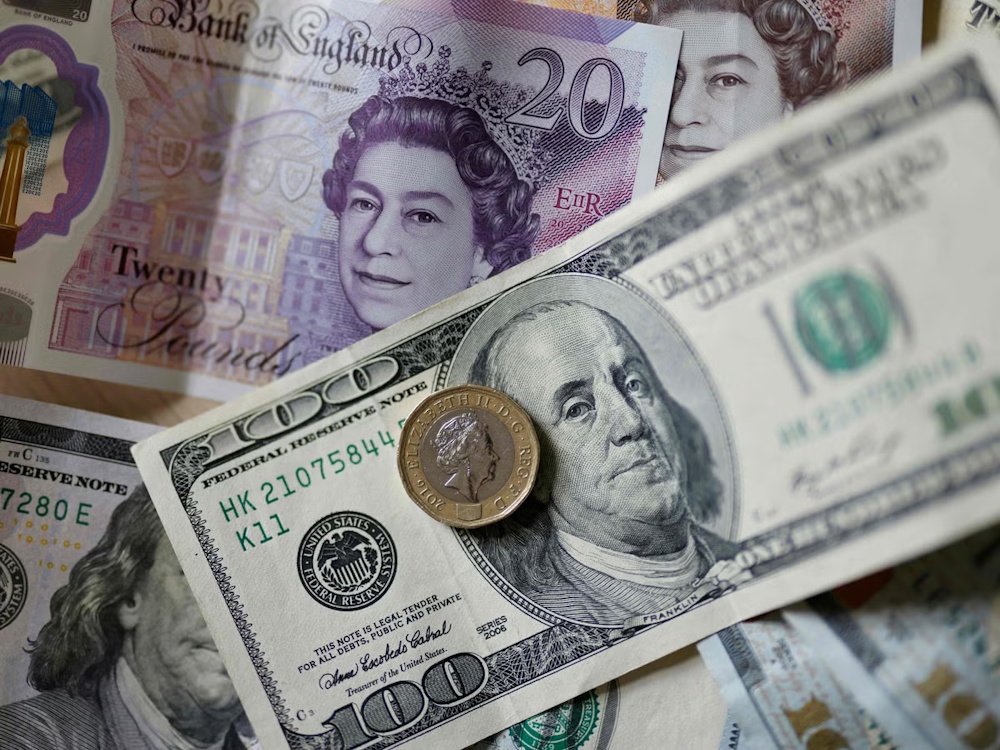
GBP/USD is currently at 1.3500 on Wednesday, May 13, 2026, following a 10-day low after experiencing a third consecutive day of losses against a strengthening U.S. dollar. The session has yielded a decline ranging from 0.25% to 0.57% on the day, contingent upon the data source, with intraday figures converging around 1.3500 according to one source, 1.35062 from another, 1.3513 as per a different chart, and 1.3550 noted earlier in the European session prior to the acceleration of the breakdown. The cross-currency map illustrates the extent of the dollar’s movement — the USD has appreciated by 0.25% relative to the GBP, 0.19% against the EUR, 0.11% versus the JPY, 0.16% in relation to the AUD, 0.12% against the CHF, and 0.37% compared to the NZD during the session, while experiencing a slight decline of 0.02% against the CAD. Sterling has positioned itself as the second-weakest G10 currency against the dollar, following the New Zealand dollar. This relative weakness can be attributed to two concurrent factors impacting Cable from opposing directions: a hotter-than-expected U.S. CPI print that has fundamentally altered Federal Reserve policy expectations towards rate hikes instead of cuts, and an escalating political crisis in Westminster that has driven UK gilt yields to levels reminiscent of the late 1990s. The U.S. Dollar Index has strengthened by 0.2% to 98.50, with the upper boundary of the descending channel at 98.59 serving as the next key pivot point for direction. The pair is currently evaluating the white ascending trendline support established from the early-May low at 1.3510, following a decline from the red moving average at 1.3535. The technical structure is increasingly indicating a potential breach of the 1.3500 psychological threshold.
The April Consumer Price Index print released Tuesday accelerated to 3.8% year-on-year from 3.3% in March, surpassing consensus estimates of 3.7% and delivering the most pronounced hawkish surprise of the year. The core CPI reading increased to 2.8%, up from the previous 2.6%. The combined headline and core acceleration was influenced by ongoing shelter inflation and increasing energy prices from earlier in the year, with the U.S.-Iran ceasefire permitting some oil to flow again, yet insufficient to alter the prevailing pricing trend. The market’s response was both swift and significant — CME FedWatch probabilities for at least one Federal Reserve interest rate hike in 2026 increased to 35.6% from 23.5% prior to the CPI release, marking a 12 percentage point rise in just one session that fundamentally alters the rate-differential calculations for every dollar pair. The April Producer Price Index released Wednesday morning provided additional support for the prevailing trend, with consensus expectations for headline PPI at 4.9% year-on-year compared to 4.0% in March, and core PPI at 4.3% year-on-year versus 3.8% previously — data that would reinforce the narrative of persistent inflation if realized as anticipated. The 10-year U.S. Treasury yield stands at 4.48%, marking a 10-month high that inherently increases the opportunity cost of holding non-dollar currencies and eliminates the structural floor that had been underpinning Cable during the late-April recovery. The convergence of an unexpectedly high CPI, an impending elevated PPI, and the forthcoming transition at the Fed on Friday establishes a robust and sustained bullish case for the dollar within the G10 complex, the strongest seen in months.
Prime Minister Keir Starmer is encountering a significant leadership challenge during his time in office, as Health Secretary Wes Streeting is said to be readying his resignation as early as Thursday to initiate a formal leadership contest. Streeting confronted Starmer on Wednesday morning during a 16-minute meeting ahead of the King’s Speech. Labour Party insiders are now openly discussing the timeline for Starmer’s exit rather than contemplating his ability to withstand the current pressures. The catalyst for the crisis was Labour’s poor showing in the local elections — the party experienced a decline of 202 councillors, while the Conservatives lost 61. In contrast, Reform UK saw an increase of 270 councillors, the Liberal Democrats gained 29 seats, and the Greens added 23 to their tally. The 202-seat collapse on the Labour side signifies the most significant council-level performance decline for a sitting government in decades, effectively dismantling the political shield that Starmer had been utilizing since the general election less than two years prior. Starmer has publicly asserted his intention to remain Prime Minister, yet market dynamics have shifted beyond the inquiry of his tenure. They are now assessing the likelihood of his departure occurring on his own accord as opposed to being compelled to resign. Kathleen Brooks, research director at XTB, has articulated the situation clearly — should this evolve into a protracted leadership contest or if Starmer provides a timeline for his exit, both Starmer and Chancellor Rachel Reeves will be perceived as ineffective leaders lacking authority over fiscal matters. This scenario would be detrimental for the UK, particularly considering that the last general election occurred less than two years ago. The bond market has commenced the process of pricing in that scenario with notable decisiveness.
The movement in the bond market beneath Sterling represents the most significant macroeconomic indicator influencing the GBP/USD decline. The 10-year UK gilt yield has ascended past 5.10%, with the 20-year and 30-year UK yields reaching 26-year peaks — levels not observed since the late 1990s. Typically, higher yields would bolster a currency via the rate-differential mechanism; however, the present shift is influenced more by apprehensions regarding fiscal sustainability than by anticipations of monetary policy tightening, presenting a fundamentally contrary signal. Kit Juckes of SocGen has articulated the current situation: the expectation of increased spending under a new Labour leadership is established, the likelihood of higher taxes, including those on wealth and housing, is nearly assured, and this fiscal context, compounded by geopolitical uncertainties and escalating energy costs, alongside a decline in UK 2026 consensus GDP growth forecasts from 1.1% at Christmas to 0.8% now, presents minimal prospects for Sterling appreciation. The commentary from the Bank of England has underscored a prudent perspective — the BoE is anticipated to uphold a restrictive approach as inflation continues to exceed the target, according to the latest Reuters poll. Catherine Mann, a member of the Bank of England’s Monetary Policy Committee, has made it clear that monetary policy is unable to counteract cost-push shocks stemming from energy prices. This indicates that the central bank is not planning to implement aggressive rate cuts to bolster the economy, despite signs of weakening growth. The interplay of fiscal blow-out risk, political instability, the Bank of England’s restrictive policy, and a deteriorating growth outlook forms a perfect storm for Sterling, independent of the dollar’s movements on the opposite side of the pair.
The chart structure for GBP/USD has exhibited a pronounced bearish rotation over the last three sessions. The pair is presently positioned beneath the 20-day Exponential Moving Average at 1.3530, having been unable to surpass the 61.8% Fibonacci retracement of the most recent swing at 1.3602. The Relative Strength Index stands at 49.6, positioned near the neutral threshold, signaling a decrease in upward momentum. This implies that any potential rallies are likely to be limited as long as the price remains below the immediate convergence of dynamic and Fibonacci resistance levels. On the upper side, the immediate resistance levels are marked by the 50.0% retracement at 1.3518, followed by the 20-day EMA at 1.3530, the 61.8% retracement at 1.3602, the 78.6% retracement at 1.3721, and finally the 100% retracement at 1.3873. On the downside, the initial support is located at the 38.2% Fibonacci retracement level around 1.3434, with a more substantial floor at the 23.6% level near 1.3331, and the structural anchor positioned at 1.3163 should the breakdown continue. The intraday 2-hour chart indicates that the price is currently testing the white ascending trendline established from the early-May low at 1.3510, while the red moving average at 1.3535 serves as immediate resistance. The Volume Profile indicates that the 1.351 zone represents the fair value gap where buyers are entering the market. However, structural pressures suggest that a decisive break below the 1.3500 floor could lead to further downside movement. The Daily Bollinger configuration indicates that the price is situated beneath the 20-day SMA at 1.3540 while remaining above the 100-day SMA at 1.3483. The lower Bollinger band at 1.3458 serves as a significant support level in the event of a more pronounced pullback.
