
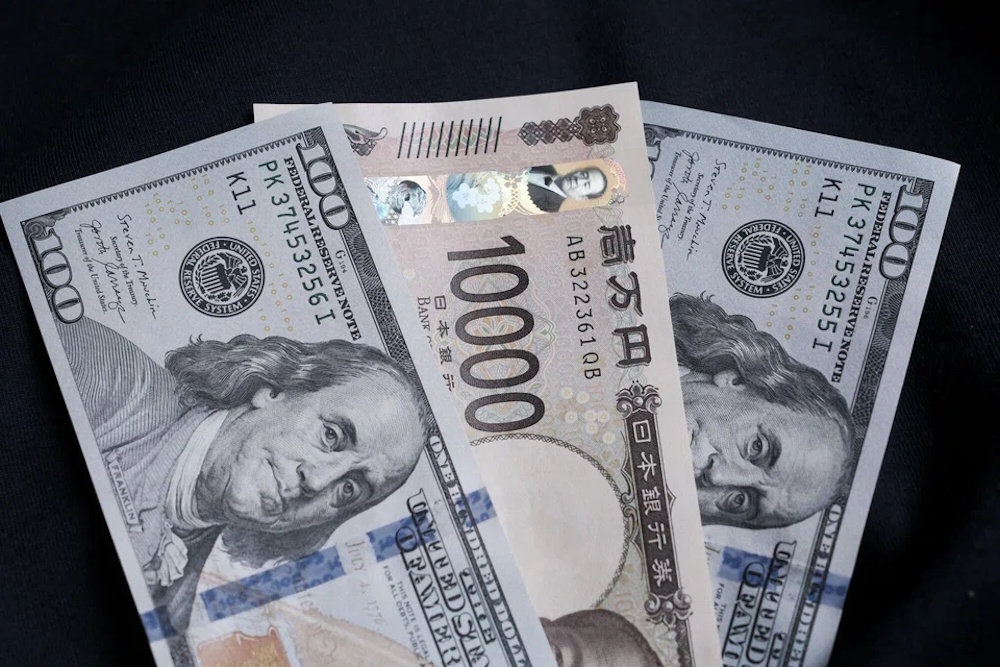
The Japanese currency experienced a notable decline against the dollar during Monday’s session, with USD/JPY trading at 157.26 — reflecting a 0.10% increase for the day. The pair managed to regain the 157.00 psychological level after previously dipping to the 156.50-156.45 range in early Asian trading. This movement was influenced by a broader risk premium related to Iran, which redirected flows back into the dollar and exerted downward pressure on the yen across the market. The pair finds itself caught between two contrasting structural influences that dictate every significant movement on the cross — on one side, the harsh energy-import calculations that negatively impact the yen whenever crude exceeds $100 a barrel, and on the other, the impending intervention threshold set by the Ministry of Finance, which Tokyo has consistently shown it will protect using foreign exchange reserves amounting to trillions. The immediate trigger for Monday’s movement was Trump’s outright dismissal of Iran’s updated peace framework as “TOTALLY UNACCEPTABLE” on Truth Social Sunday evening — a statement that propelled WTI sharply above $96, pushed Brent up by 2.50% to $103.80, and put the energy-import-dependent Japanese economy back under pressure. On Monday’s session, the yen experienced its most significant decline against the Canadian dollar at -0.27%, followed by a drop of -0.20% against the US dollar, -0.13% against the Australian dollar, and -0.11% against the euro. It remained largely unchanged against the British pound. This relative-strength analysis highlights that the yen’s ongoing structural underperformance is the prevailing trend, rather than being solely influenced by the strength of the dollar. The cross currently rests at a critical pivot point near 157.00, which corresponds with the ascending trendline previously anchored around 156.34, the 50-day moving average, and earlier swing lows that have characterized the medium-term uptrend channel.
The intervention activity by the Ministry of Finance during the Golden Week holiday period stands out as the most significant supply-side event in the USD/JPY complex for 2026, with the scale of capital deployed being more critical than the immediate price effects. During Golden Week, Japan’s expenditure on currency interventions ranged from ¥8.65 trillion to ¥10.08 trillion, with the higher estimate surpassing the ¥9.74 trillion utilized throughout the entirety of 2024. The primary aim of these interventions was to discourage speculators from pushing the yen down further, and in that regard, the operation was successful — net short positions held by hedge funds and asset managers decreased to a one-month low by the week ending May 5. Market participants analyzing the data understood that Tokyo was serious, leading to a swift decision to reduce short positions instead of persisting in betting against the yen. The underlying issue lies within the funding structure — a significant portion of Japan’s $1.2 trillion in foreign exchange reserves is comprised of US Treasury bonds, and the Federal Reserve’s custody-holdings report indicates a decrease in Japanese holdings that corresponds directly with the timing of the intervention. Tokyo is effectively funding yen-strengthening measures through the sale of US Treasuries, which in turn drives Treasury yields upward — a scenario that runs counter to Washington’s objective of reducing borrowing costs. Goldman Sachs assesses that Japan maintains the ability to execute interventions comparable to those conducted from late April to early May, indicating that the intervention threshold continues to serve as a reliable deterrent despite the significant deployment. The futures market currently indicates a 72% likelihood of a Bank of Japan rate hike in June, as derivatives traders anticipate a continuation of the monetary tightening cycle, despite the BoJ’s consistent tendency to postpone action. The intervention in the currency market establishes an uneven scenario, allowing Tokyo to protect certain thresholds while being unable to alter the prevailing upward trend driven by the rate differential and the costs associated with oil imports, which continue to exert upward pressure.
The recent policy meeting of the Bank of Japan conveyed a significantly more hawkish message than what was reflected in the headlines. The 6-3 vote split on the policy decision indicates a real internal disagreement regarding the suitable timing for restarting the rate-hike cycle. The upward adjustment to inflation projections, along with the dissenting opinions, has heightened expectations for a possible rate increase as early as June. The futures market now indicates a 72% likelihood of that hike, demonstrating the market’s increasing belief that the BoJ is poised to take action. Japan’s wage data have shown significant improvement — insights from Jane Foley observes that unions achieved substantial “shunto” wage increases in the recent spring negotiation cycle, leading to a rise in real wages for the first time in years. This development offers the underlying consumption strength that the BoJ has clearly identified as a prerequisite for tightening. The recent remarks from the Deputy Governor of the Bank of Japan indicate a shift from a cautious stance to a more assertive approach regarding tightening measures. However, historical trends within Japanese institutions imply that any actual rate adjustments are likely to occur several meetings after they have been anticipated by the markets. The Bank of Japan’s recent upward revision of inflation forecasts, coupled with a hawkish vote split, has increased speculation regarding a possible rate hike as early as June. However, historical trends indicate that the central bank has a tendency to fall behind market expectations concerning timing. Should the June hike materialize, the effect on USD/JPY would be systematic — a 25-basis-point adjustment would narrow the rate differential with the Fed by 25 basis points, likely driving the pair toward the 154 range within a few trading sessions.
The potential risk to the yen-bearish outlook lies in the chance that the Bank of Japan may unexpectedly adopt a hawkish stance, implementing a rate hike along with clear forward guidance indicating further tightening into the latter half of 2026. The dynamics of Japan’s energy imports present a compelling case for ongoing yen depreciation, particularly in times of high crude prices. The extent of this transmission effect warrants greater scrutiny beyond what daily price fluctuations reveal. The nation relies on imports for about 90% of its essential energy requirements, with crude oil and liquefied natural gas constituting the most significant import categories in terms of value. A $10 increase in Brent crude prices results in approximately $20 billion in extra annual import expenses for Japan. This, in turn, systematically expands the current account deficit and exerts structural selling pressure on the yen via the trade-balance mechanism. WTI at $97.60 and Brent at $103.80 indicate prices that are approximately $40-$45 above the early-2025 baseline. This suggests that the cumulative annual import-cost penalty Japan is facing amounts to around $80-$90 billion, which is a key factor hindering the yen’s ability to achieve a sustained recovery, despite several interventions by the central bank. The ongoing disruption in the Strait of Hormuz, persisting for over two months, introduces a secondary vulnerability as Japan’s LNG imports from Qatar face significant interruptions. This situation compels Japan to seek alternative supplies from the US Gulf Coast, which come at elevated prices. Each shipment that once traversed Hormuz now must navigate longer routes, incur increased insurance costs, and contend with European buyers for the limited available volumes.
In April, Japanese imports of Russian LNG surged by 57% month-on-month, reaching EUR 163 million, as Tokyo sought alternative supply sources. This increasing reliance on more distant and politically complex LNG suppliers further underscores the narrative of structural yen weakness through the trade channel. The implications for USD/JPY positioning are clear — with each passing day that Trump’s rejection of Iran maintains the Hormuz blockade, the yen faces a fundamental structural disadvantage that intervention may mitigate but cannot fully rectify. The interest-rate differential between Japan and the United States continues to be the primary fundamental factor influencing USD/JPY price movements in the medium term. The existing 350-basis-point spread between the Fed’s 3.50%-3.75% target range and the BoJ’s 0.50% policy rate signifies a yield advantage that inherently draws carry-trade flows from Japanese institutional investors. Japanese pension funds, life insurers, and asset managers seeking yield face a dilemma: they must either maintain their positions in low-yielding domestic bonds or shift towards higher-yielding foreign assets, with US Treasuries standing out as the most liquid and accessible option for such a transition. The flow architecture is fundamentally structural and functions on a scale that surpasses any tactical intervention efforts. The Federal Reserve’s hawkish stance, alongside Trump’s ongoing pressure regarding the Iran situation, has contributed to sustained elevated oil prices. This dynamic has strengthened expectations that the Fed will maintain a tighter policy for an extended period.
According to CME FedWatch, there is approximately a 20% probability of a Fed rate hike before the end of the year, influenced by the inflationary effects stemming from energy prices. The overall impact indicates that even if the Bank of Japan proceeds with its anticipated June hike, which the futures market currently estimates at a 72% likelihood, the rate differential is expected to narrow from 350 basis points to 325 basis points. This differential remains sufficiently broad to sustain ongoing carry-trade operations and to avert a prolonged yen appreciation that would necessitate a fundamental alignment in rate cycles. The positive US Nonfarm Payrolls report published on Friday reinforced expectations for a hawkish Federal Reserve and served as a boost for US Treasury bond yields, offering further fundamental backing for the dollar, which is reflected in the strength of USD/JPY. The resurgence of inflationary worries stemming from the oil shock has led to an upward shift across the US yield curve, with the 10-year Treasury surpassing 4.5% and the 2-year remaining above 4.0%. This yield structure significantly enhances the appeal of the yen carry trade when evaluated on a risk-adjusted basis.
