
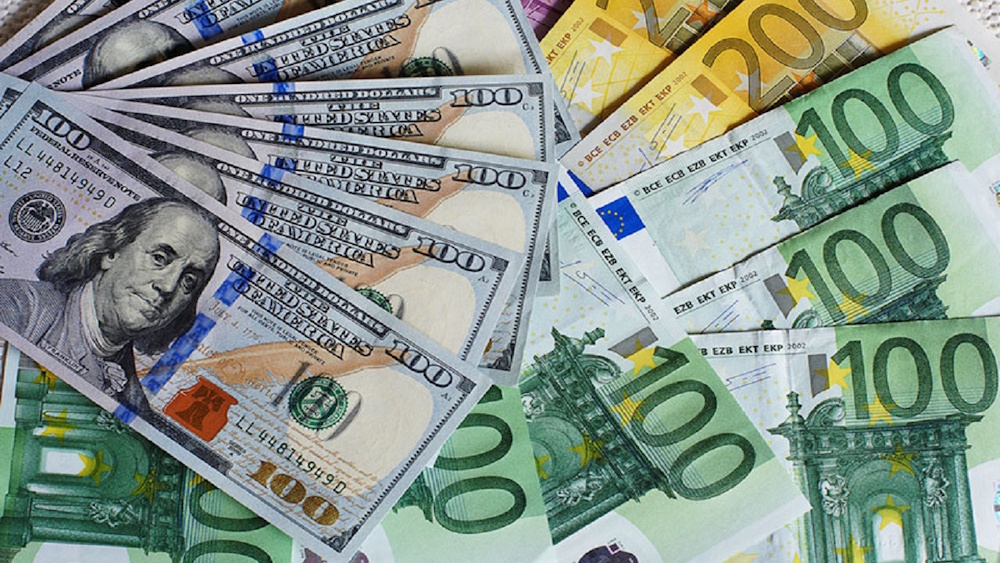
EUR/USD fell to around 1.1420 on Tuesday, declining slightly during the session but remaining at its lowest level since mid-March. This movement reflects a global flight from risk, which has bolstered the dollar’s appeal as a safe haven, in addition to the interest rate advantage it currently possesses. The pair has remained confined within a narrow range just above 1.1400 during European trading, exhibiting a defensive posture, as the dollar maintains an advantage amid a risk-off sentiment and a hawkish stance from the Federal Reserve. The chip rout tearing through equity markets worldwide didn’t just hit stocks — it redirected capital into the deepest, most liquid safe haven on earth, and that’s the dollar, not the euro. The thesis here is specific and it’s the key to the whole pair: EUR/USD is constrained by the policies of two hawkish central banks, which explains its inability to break out in either direction. The Fed, now led by Chair Kevin Warsh, has indicated forthcoming rate hikes, propelling the dollar to approach its highest level since May 2025. The European Central Bank has increased interest rates for the first time since 2023 and is indicating further adjustments ahead. When both sides of a currency pair are supported by a robust central bank, the pair becomes constrained — neither the bulls nor the bears can achieve a clear victory, resulting in the price oscillating within a defined range. Currently, the range is trending downward due to the dollar’s hawkish narrative being more dominant, which has led to the euro positioning itself at the weaker end as a consequence.
That represents a significant shift from the prevailing narrative that characterised the early months of 2026. At that time, every major bank projected EUR/USD to ascend toward 1.22–1.25 by the end of the year, predicated on the expectation that the Fed would continue its rate cuts while the ECB maintained its position. That assumption has been thoroughly dismantled. The Fed isn’t cutting — it’s signalling a potential increase. Once the repricing commenced, the bullish case for the euro lost its momentum. The euro isn’t collapsing; it is currently range-bound and capped, while the dollar has taken a firm position in the driver’s seat. The level that delineates the floor resides just beneath the current price, with PCE on Thursday serving as the pivotal factor that determines its stability. Here is the current position of the pair. The EUR/USD exchange rate is currently positioned at approximately 1.1420, reflecting a decline of about 1.9% over the preceding month and a decrease of approximately 1.65% over the last twelve months. This level represents the lower boundary of the range maintained throughout the year. The 2026 low near 1.1435 was recorded on March 15, and the pair is currently examining and probing those March levels — marking the weakest position of the euro against the dollar since the spring. In contrast, the January peak around 1.20 now appears as a remnant of the past; the pair has relinquished a significant portion of the 2025 rally that propelled it from the low 1.0000s.
The character of the move is a measured progression, not a sudden impact. The EUR/USD exchange rate commenced 2026 at approximately 1.17, experienced a rise towards 1.20 in January, retraced to 1.14 in March, rebounded towards 1.17 by late April, and has subsequently declined back to the 1.14 region as the dynamics between the Federal Reserve and the European Central Bank shifted unfavourably for the euro. The pair has spent the year within a clearly delineated range, and at present, it is testing the lower boundary of that range rather than decisively breaking free from it. The dollar index surpassed 100 in June and has maintained its position, reflecting the corresponding weakness of the euro. What the scoreboard captures is a currency that is not in trouble so much as it is constrained. The euro benefits from a hawkish central bank, which serves to prevent its collapse. However, it contends with a dollar supported by a more hawkish central bank and a safe-haven demand, which inhibits its ability to rally. The result is at the lower end of a range, with the pair seeking a catalyst — PCE Thursday and the July ECB meeting being the two events on the calendar — to determine the direction of the movement.
The single most important fact about EUR/USD at this moment is that both central banks have pivoted hawkish within days of one another, and this is what is anchoring the pair. The ECB raised its deposit rate to 2.25% from 2.00% on June 11, marking its first hike since 2023. Money markets are now pricing in at least one more increase before the end of the year. The Fed maintained its stance at 3.50–3.75% on June 17, yet indicated potential rate hikes ahead, as nine of its 19 policymakers now foresee at least one increase occurring in 2026. Two hawks, one pair, and the outcome is a stalemate characterised by a tug-of-war, with neither party able to deliver a decisive blow. This represents a significant shift from the framework that propelled the euro’s rally in 2025. For the majority of the previous year, the trade dynamics were straightforward: the Federal Reserve was implementing cuts, the European Central Bank was either maintaining its stance or easing at a more gradual pace, resulting in a narrowing rate differential that favoured the euro, consequently leading to an increase in EUR/USD. That narrowing differential constituted the fundamental bull case, and it proved effective — the pair surged from the low 1.0000s to nearly 1.20. The two-hawk trap disrupted that mechanism. With both central banks now leaning toward tighter policy, the differential is no longer compressing in favour of the euro; if anything, the hawkish repricing by the Fed has shifted it back toward the dollar.
The practical consequence is a pair confined within the mid-to-lower range, lacking a definitive trajectory towards a breakout. As one currency strategist framed it, the ECB pivoted to tightening just as the Fed turned hawkish too, so both sides of EUR/USD are firm, which is why the pair is range-bound rather than trending. The hawkish ECB establishes a support level for the euro — it becomes challenging to aggressively sell the currency when its central bank is in the process of increasing interest rates. The hawkish Federal Reserve and robust dollar impose a constraint on it. The euro occupies a central position, with the slope of that range influenced by the hawkish stance the market favours, currently leaning towards the Fed. Prioritise the dollar side initially, as it carries greater significance. Warsh, who assumed the role of Fed Chair in May 2026, utilised the June meeting to reinforce a hawkish stance — maintaining the current rate while removing any dovish language from the statement and explicitly expressing his commitment to reducing inflation, currently at 4.2%, towards the 2% target. The projections conveyed a clear message: nine of 19 policymakers anticipate at least one rate hike by the end of the year, while both Deutsche Bank and BofA have adjusted their forecasts to incorporate a potential increase in September. The market has adjusted accordingly, assigning approximately a 70% probability of an interest rate increase by September.
The dollar’s response has been unequivocal. The US Dollar Index surpassed the 100 mark in June following the Federal Reserve’s hawkish stance and has maintained its position near the highest level observed since May 2025. A robust dollar exerts a direct, mechanical influence on EUR/USD — the pair represents the dollar’s value relative to the euro, thus, dollar strength inherently translates to euro weakness. The hawkish stance of the Federal Reserve and the strength of the dollar represent two facets of a singular influence, which is exerting downward pressure on EUR/USD. This occurs despite the euro’s own monetary narrative becoming more hawkish concurrently. The dollar’s safe-haven character amplifies the impact on a day such as today. As a global technology downturn prompts a withdrawal of capital from risk assets across the globe, investors are increasingly directing their funds into the most secure and liquid market, namely U.S. Treasuries and the dollar that facilitates their purchase. Thus, the risk-off event that could have previously buoyed the euro as an alternative to the dollar now serves to strengthen the dollar itself, pushing EUR/USD closer to the lower end of its range. The greenback is currently reaping advantages from both the interest rate narrative and the prevailing climate of uncertainty, while the euro finds itself adversely positioned in relation to both factors.
