
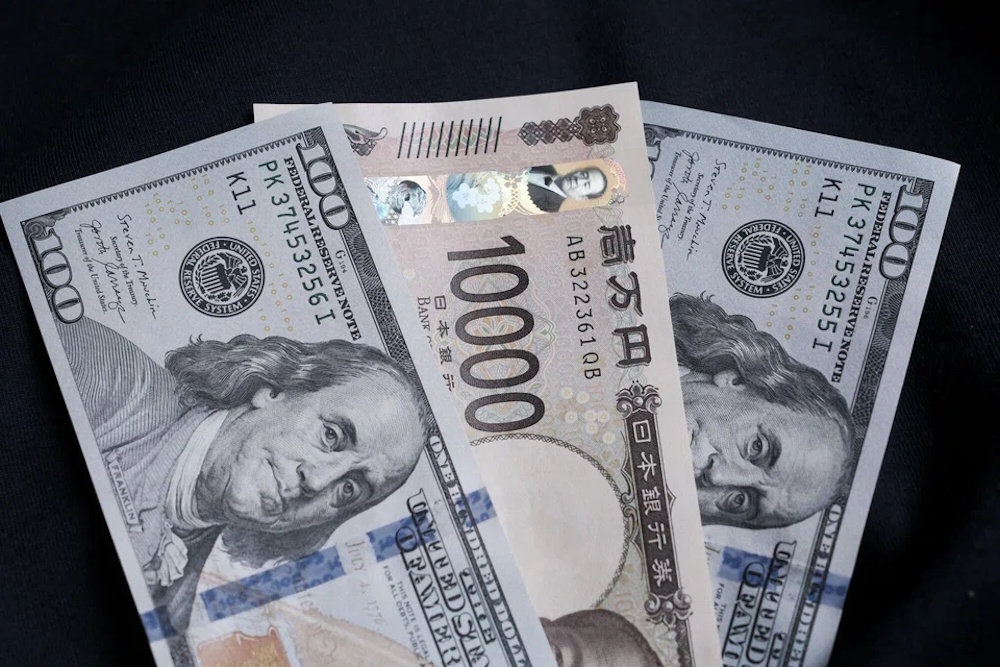
The Japanese yen weakened to around 161.5 per dollar Monday, hovering near its lowest level since 1986 as repeated verbal interventions from Tokyo failed to halt the currency’s decline. USD/JPY pushed beyond 161 on Friday and extended the move into the new week, with the yen having now surrendered all the gains it made on April 30, when officials carried out a record-sized market intervention to support the currency. The four-decade low is back in view, and the warnings from Tokyo are not working. The remarkable part is the context: the yen is sinking despite the Bank of Japan tightening. The BoJ raised its policy rate by 25 basis points to 1% just last week, a hike aimed at addressing an energy-driven inflation shock linked to the Middle East conflict. Yet even an actual rate increase could not arrest the yen’s slide, because the move did almost nothing to close the vast gap between Japanese rates at 1% and US rates at 3.50% to 3.75%. When a currency falls even as its central bank hikes, the message is that the rate differential — not the direction of policy — is what matters. The thesis here is that the yen is trapped by the rate gap. The hawkish Federal Reserve under Kevin Warsh out-hawks a Bank of Japan that has only crept to 1%, leaving a differential of roughly 250 basis points that fuels relentless carry-trade selling of the yen. Not the BoJ’s rate hike, not a record-sized intervention, not the steady drumbeat of verbal warnings has been able to overcome that carry. USD/JPY is pinned near its 1986 high because the fundamental force — the rate gap — overwhelms everything Tokyo throws at it.
This is what distinguishes the yen from the other majors. The euro is squeezed between two hawkish central banks at similar rate levels; the pound carries a political crisis layered on the dollar story. The yen is the cleanest expression of the rate-differential and carry-trade dynamic — a funding currency being sold to finance higher-yielding positions, with a structural energy-import deficit compounding the weakness and an intervention threat hanging over the tape. USD/JPY trades like a pure rates-differential story, particularly at the front end of the curve. The levels frame the trade. The 160 round number is the line that defines the intervention zone, the 1986 high near 161-162 is the multi-decade ceiling the pair is testing, and the 200-day moving average near 153.80 is the distant support far below the current price. The Ministry of Finance’s verbal warnings mark the intervention tail risk, Thursday’s PCE inflation print is the macro switch, and the only thing that genuinely reverses the trend is a turn in the US rate outlook — not Tokyo’s words. Everything between here and Thursday is positioning around the 160 intervention line.
The dominant force driving USD/JPY is the interest-rate differential between the United States and Japan, and it is enormous. With the Federal Reserve holding at 3.50% to 3.75% and the Bank of Japan at just 1% after last week’s hike, the gap sits around 250 basis points — and it was even wider, near 325 basis points, earlier in 2026. That differential is the gravitational force pulling capital out of yen and into dollars, and it is the single most important variable in any USD/JPY forecast. The carry trade is the mechanism. When US rates sit 250 basis points above Japanese rates, investors borrow in cheap yen and invest in higher-yielding dollar assets, pocketing the spread. That carry trade requires selling yen and buying dollars, which mechanically pushes USD/JPY higher. As long as the rate gap stays wide, the carry trade remains profitable and the structural selling pressure on the yen persists. The yen has become the world’s premier funding currency, and that role guarantees a steady supply of yen selling. The persistence of the gap is the problem for yen bulls. The bull case for the yen has always rested on the gap compressing — the BoJ tightening while the Fed eased, narrowing the differential and unwinding the carry. That thesis worked when the Fed was cutting, but it has been turned on its head by the hawkish Warsh Fed. Instead of the gap compressing, it is staying wide or even widening as the Fed prices hikes while the BoJ creeps higher only slowly. The compression that yen bulls needed is not happening.
The front-end sensitivity is the key technical feature. USD/JPY trades like a rates-differential story particularly at the front end of the curve, meaning it responds most to the short-term rate expectations that the central banks control directly. As markets price the risk of Fed hikes, the front-end US-Japan spread widens, and USD/JPY tracks it higher. That tight relationship between the rate spread and the exchange rate is why the pair has been so relentlessly bid — the fundamental driver is pushing in one direction, and the yen has little to counter it. For the forecast, the rate gap is the structural engine of yen weakness, and it shows no sign of closing. At roughly 250 basis points, the differential fuels the carry trade and the relentless yen selling that has pushed USD/JPY toward its 1986 high. The only thing that reverses this is a genuine compression of the gap — either the Fed turning dovish or the BoJ hiking far more aggressively than its cautious 1%. Until that happens, the rate gap keeps the yen pinned at multi-decade lows, and every rally in the yen is a counter-trend move against the fundamental carry. The gap is the gravity, and it points toward a weaker yen. The most telling event for the yen was last week’s Bank of Japan rate hike, and what is remarkable is how little it accomplished. The BoJ raised its policy rate by 25 basis points to 1%, continuing its historic normalization away from decades of zero and negative interest rates, with the hike aimed at addressing an energy-driven inflation shock linked to the Middle East conflict. Yet the yen weakened anyway, pushing toward its 1986 low — a stunning demonstration that even an actual rate increase cannot overcome the rate gap.
The reason the hike failed is the math. A 25-basis-point increase to 1% barely dents a 250-basis-point differential with the United States. The carry trade remains overwhelmingly profitable at a 1% Japanese rate versus a 3.75% US rate, so the structural yen selling continued unabated. The BoJ’s hike was a step in the right direction for yen bulls, but it was far too small relative to the gap to change the fundamental calculus. Tightening into a still-vast differential is like bailing water against a tide. The energy-inflation context is important. The BoJ’s hike was driven in part by an energy-driven inflation shock — the Middle East conflict pushed up energy prices, and because Japan imports virtually all its energy, that fed directly into Japanese inflation, forcing the central bank to respond. That is a difficult position: the BoJ is hiking not because the economy is strong but because imported inflation is forcing its hand, which is a less convincing foundation for sustained tightening. An inflation-driven hike into a weak economy is harder to extend than a growth-driven one.
The BoJ’s cautious normalization is the structural constraint. Under Governor Kazuo Ueda, the BoJ has moved deliberately — from negative rates to 0.25%, then 0.50%, and now 1% over roughly two years. That gradualism reflects genuine caution about Japan’s fragile growth and the risk of choking off the recovery, but it means the BoJ is perpetually behind the rate gap. The market has learned that the BoJ will not hike fast enough to close the differential, which is why each hike produces little lasting yen strength. The pace of normalization is the problem. For the forecast, the BoJ’s impotence is the clearest signal that the yen’s fate lies with the Fed, not Tokyo. If a 25-basis-point hike to 1% cannot stop the yen’s slide, then the BoJ alone cannot reverse the trend — it would need to hike far more aggressively than its cautious approach allows. The energy-inflation driver and the fragile growth backdrop constrain how fast the BoJ can move, leaving the rate gap wide. The yen’s recovery requires the US side of the differential to turn, because the Japanese side is moving too slowly to matter. The BoJ hiked, and the yen fell — that is the whole story.
