
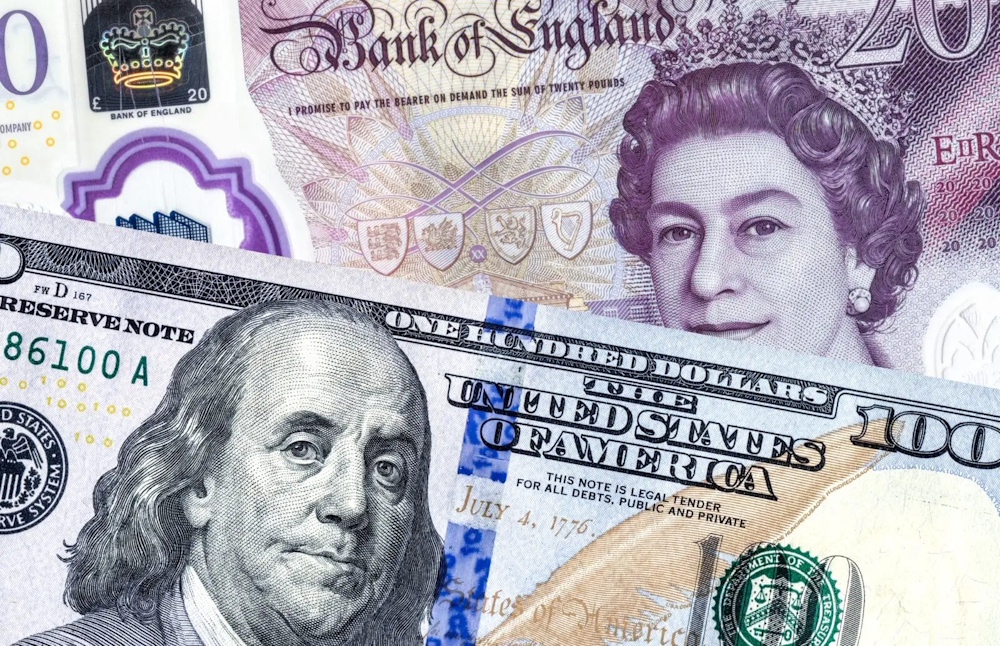
Cable finds itself ensnared in a predicament similar to that of the euro: as the central bank adopts a hawkish stance, the currency continues to decline regardless. GBP/USD declined to 1.3449 on Wednesday, reflecting a decrease of approximately 0.13% during the session and marking its lowest point since early April, significantly below the multi-year peak of 1.3869 reached in late January. The pound has experienced a decline of approximately 0.61% over the past month, following a monthly decrease exceeding 1% against the dollar, while the anticipated rebound remains elusive for bullish investors. The conundrum lies in the fact that the Bank of England is anticipated to increase interest rates rather than decrease them, yet sterling remains unable to attract demand. The market has shifted from anticipating cuts by the Bank of England to pricing in nearly two rate hikes in 2026; however, the pound continues to decline steadily. The rationale mirrors that which is affecting the euro: a defensive hiking cycle, with a central bank compelled to tighten in response to an imported energy-inflation shock, all while the domestic economy shows clear signs of weakening. Layer a firm dollar on top, and you find a currency anchored near the lower end of its range. The entire outlook is now contingent upon the Bank of England’s decision on June 18 and the surrounding central bank dynamics, with 1.34 serving as the support level that remains intact and 1.36 representing the resistance that the bulls must recapture.
The rate outlook has shifted dramatically, reflecting significant changes in economic conditions and expectations. This evolution underscores the complexities of monetary policy and its implications for various sectors. The adjustments in forecasts highlight the responsiveness of markets to evolving economic indicators and central bank communications. Markets currently anticipate approximately 50 basis points of additional tightening from the Bank of England this year—equivalent to nearly two complete 25-basis-point increases—with the initial hike fully accounted for in the September meeting. That represents a total turnaround from the expectations held at the beginning of the year, when the prevailing view was that the Bank would implement rate cuts in 2026. The catalyst for the flip was the Iran energy shock: when Tehran threatened to suspend negotiations and block the Strait of Hormuz, oil prices spiked, prompting investors to immediately raise their expectations for BoE rate hikes to address the inflationary fallout. The hawkish signals are emanating from within the institution as well. BoE policymakers have upheld a resolute position on inflation, with one member articulating distinctly hawkish comments that indicated an increasing rationale for rate hikes and emphasised that the pace of the policy response is as significant as its magnitude. The UK Bank Rate currently stands at 3.75%, with market expectations indicating a potential increase ahead. In a typical economic cycle, a central bank transitioning from interest rate cuts to hikes would result in a significant appreciation of its currency. The fact that sterling is behaving contrarily indicates that the market has shifted its attention away from the trajectory of interest rates and is instead concentrating on the underlying reasons prompting the Bank’s actions — and that “why” constitutes the core issue.
Herein lies the rationale for why the hike does not present a bullish outlook for the pound. UK inflation has been persistently elevated, with the Consumer Price Index reaching 3.3% earlier this spring, an increase from 3.0% the previous month and significantly surpassing the Bank’s target of 2%. This rise has been primarily influenced by increases in motor fuels, housing, and utilities. The energy component is crucial, as the conflict in Iran and the associated threats to Hormuz have driven up oil and gas prices, significantly impacting the UK’s energy imports. That represents a cost-push shock originating from overseas, rather than an indication of robust domestic demand exerting upward pressure on prices. This is the same dynamic suffocating the euro, and it is equally detrimental for sterling. Inflation resulting from an external energy shock does not draw in capital as demand-driven inflation does; instead, it diminishes household purchasing power and increases input costs for businesses, thereby constraining the economy rather than showcasing its robustness. The Bank of England must address the inflation figures to maintain its credibility; however, the market perceives the central bank as tightening in response to a headwind that it neither generated nor can manage. A hike that combats imported inflation amidst a weakening economy is not the type of increase that currency traders are inclined to support. That is the fundamental reason the pound is unable to translate a hawkish Bank of England into a more robust sterling.
The domestic data highlights the tangible issues facing the pound, revealing a more troubling situation in Britain compared to the eurozone. UK house prices experienced a decline of 0.6% in May, a significantly sharper decrease than the anticipated 0.1%, marking the largest monthly drop since June 2025. The decline was attributed to diminishing consumer confidence and the economic pressure stemming from escalating energy prices associated with the Iran conflict. When the housing market, a critical component of UK consumer wealth and sentiment, begins to decline sharply, it indicates an economy struggling under the pressures of the cost-of-living crisis. This situation exemplifies stagflation-lite: inflation compelling the Bank to increase rates, while the real economy deteriorates under the burden of those very price pressures. The Bank of England is facing pressure to tighten its policy precisely when the housing market and consumer confidence are least equipped to handle such changes. Every hike priced into the curve also tightens the screws on mortgage holders and households already cutting back, which is why the market will not reward sterling for the hawkish path. A central bank increasing interest rates amidst a declining housing market and diminishing confidence is indicative of distress rather than strength. Until the UK data stabilises, the pound’s hawkish rate narrative continues to be overshadowed by its deteriorating growth outlook.
The other half of the pair currently exhibits a robust and impenetrable structure. The dollar has strengthened, approaching an index reading close to 99, driven by robust US economic data and a hawkish stance from the Federal Reserve. The ISM Manufacturing PMI increased to 54 in May, rising from 52.7 in the previous two months, marking the most robust factory expansion since May 2022. The labour market demonstrated robust strength, as April JOLTS job openings surged to a nearly two-year high of approximately 7.6 million, accompanied by a decline in layoffs. Additionally, ADP private payrolls reported an increase of 122,000 for May. That is an economy operating at a level sufficient to maintain the Federal Reserve’s current stance. With Kevin Warsh assuming the role of Fed chair and his inaugural meeting approaching, the market is preparing for the central bank to affirm a hawkish stance — with no additional adjustments anticipated until 2026 — as a PCE reading nearing a three-year peak and oil prices approaching $97 undermine any arguments for rate cuts. That is the pressure on GBP/USD from the dollar perspective: even as the pound’s own interest rate narrative became more aggressive, the dollar’s narrative shifted to a more aggressive stance from a position of significantly stronger economic fundamentals. Friday’s US nonfarm payrolls report arrives at a critical juncture for the Federal Reserve’s decision-making process. A robust figure could strengthen the dollar and push the GBP/USD pair back toward the 1.33 level. The pound is contending with a dollar supported by the most robust US data in years, and it is faltering.
