
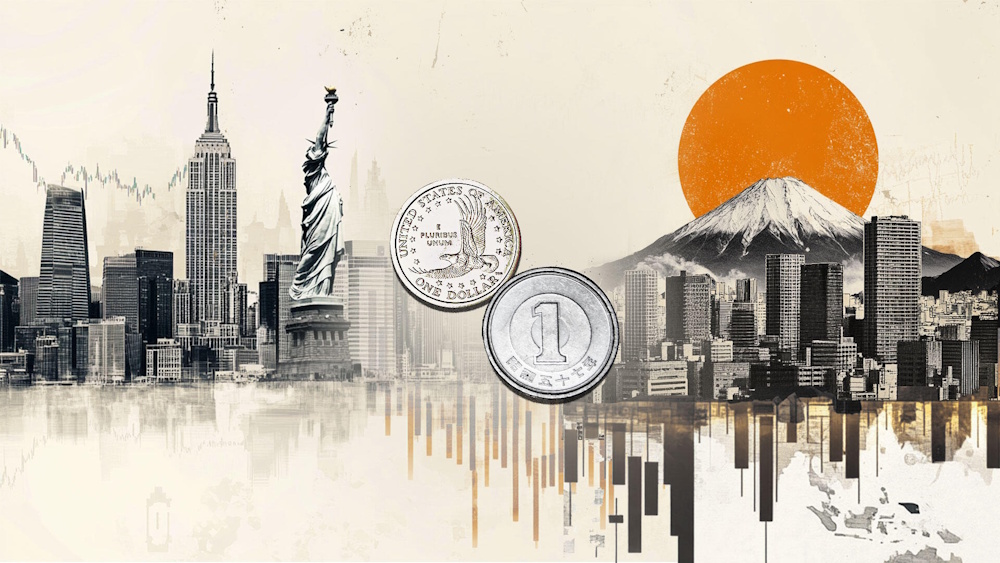
USD/JPY is currently trading at approximately 161.70, having previously peaked in July above 162.80, which positions the yen precariously close to a 40-year low. The pair recorded 162.83 on June 30, marking the weakest level for the Japanese currency since 1986, and has since remained in the low 160s for the past three weeks. The Dollar Index is currently at 100.75, having reached a peak of 100.79 during the overnight session. Now consider the factors that support the yen. The Bank of Japan raised its policy rate by 25 basis points to 1.00% on June 16, marking the highest level since September 1995, with a decision supported by a seven-to-one vote. Japanese authorities allocated a historic ¥11.7 trillion — approximately $73 billion — to purchase yen in the open market from late April to late May. The BOJ’s own summary of opinions indicates that it is deemed appropriate to persist in increasing the policy rate. The IMF anticipates two additional rate increases this year, followed by another in 2027. The yen has reached a level not seen in 40 years. The thesis posits that the divergence trade, which has been anticipated by many, has already occurred and has proven ineffective. As 2026 approached, the framework appeared straightforward: the Bank of Japan aimed to tighten its policy to a range of 1.00% to 1.25%, while the Federal Reserve sought to ease towards a range of 3.50% to 3.75%. Consequently, the differential was expected to narrow from approximately 325 basis points to between 250 and 275 by the fourth quarter. That compression constituted the entirety of the bullish argument for the yen. Both halves were delivered promptly. The Bank of Japan is currently positioned at 1.00%. The Federal Reserve’s current interest rate stands between 3.50% and 3.75%. The differential stands at 262.5 basis points at the midpoint, situated within the Q4 target range, achieved in June, four months ahead of the anticipated timeline.
USD/JPY reached a level of 162.83. That is the most significant fact in this pair, and it appears that very few have acknowledged it. The compression arrived, the yen did not rally, and the reason is that 262.5 basis points still pays. The carry does not unwind as rates converge gradually. It unravels when it unravels with intensity. Intervention has the capacity to mitigate a decline, penalise speculative overreach, and convey official unease. It cannot repeal arithmetic. The June meeting was anticipated to be a pivotal moment, and it warrants meticulous scrutiny due to its utter failure. At its meeting on June 16, the BOJ reached a decision with a seven-to-one vote to increase its policy rate by 25 basis points to 1.00%, effective June 17. That elevated borrowing costs to their highest level since September 1995 — a 30-year peak — and signified the first increase since December, when the bank adjusted to 0.75%. Board member Asada Toichiro was the only dissenting voice, highlighting the increased downside risks to production and employment stemming from spillovers in the Middle East. The path is worth laying out. The BOJ exited negative rates in March 2024, marking its first increase in 17 years, and concluded yield curve control in the same month. Rates increased from -0.1% to 0.25% by July 2024, then to 0.50% in January 2025, followed by a rise to 0.75% in December 2025, and finally reaching 1.00% in June 2026. That represents a tightening of 110 basis points over a period of 27 months, commencing from a level below zero. The yen has experienced a continuous decline. The June hike was characterised by a hawkish tone.
The board assessed that underlying inflation might exceed its 2.0% target in the medium term, with the deputy governor emphasising that rising crude costs have started to impact business-to-business transactions, thereby increasing the likelihood of consumer price hikes across a broader array of goods. The substantial backing from members suggested a board that is more focused on inflation issues rather than growth prospects. The April meeting resulted in a division of 6-3, with three members advocating for an increase; by June, only one member opposed this shift in stance. Following a reported expenditure of ¥11.7 trillion on intervention in May, the yen experienced further depreciation, reaching 160 and remaining at that level for the majority of June before declining to 162.83. The rate hike was, in one assessment, a Band-Aid on a bullet wound. The impetus for that increase is now undergoing a reversal. Heightened expectations regarding the reopening of the Strait of Hormuz, which had mitigated concerns over supply disruptions to Japan, afforded the Bank of Japan greater assurance to initiate the normalisation process. Six consecutive nights of U.S. strikes have restored that confidence. Japan’s headline CPI registered at 1.4% year over year in April, falling short of the 2.0% target.
The intervention record serves as the most definitive evidence that this pair does not represent a policy narrative. Between late April and late May, Japanese authorities expended around ¥11.7 trillion — approximately $72.5 billion to $73.5 billion, contingent on the conversion window — acquiring yen in the open market to support the currency. That represents the most extensive intervention campaign in the history of Japan. It briefly pushed the exchange rate back toward the mid-150s. The dollar exhibited further strengthening, propelling USD/JPY back above 160 and subsequently surpassing 162. Run the arithmetic on what 73 billion purchased. The pair experienced a decline from approximately 160 to the mid-150s, a movement of about 500 pips, before reversing the entire trajectory within a matter of weeks. Seventy-three billion dollars of foreign reserves facilitated a fleeting five-yen enhancement that endured for less than a month. That amounts to $14.6 billion for each yen of durable movement, yet the movement itself was not durable. The underlying cause is structural. Intervention alone is unlikely to reverse the yen’s decline as long as U.S. interest rates remain significantly higher than those in Japan and the dollar maintains its overall strength. The challenge for Tokyo lies less in its willingness to intervene than in the expanding divergence between the Federal Reserve and the Bank of Japan. If intervention is solely undertaken by Japan while the dollar maintains its overall strength, the impact is constrained. Tokyo possesses the reserves. It lacks the differential.
The official language remains unchanged, and it is the focal point that captures everyone’s attention. Finance Minister Satsuki Katayama indicated that the government is prepared to implement suitable measures in response to excessive fluctuations in currency values, including potential decisive actions as agreed upon between Japan and the U.S. Ministry officials have reiterated the standard statement regarding the need to respond appropriately to excessive volatility — a cautionary measure employed by Japanese desks to assess the risk of intervention. The U.S. side has provided support. The Treasury Secretary expressed support for Japan’s currency policy during a visit in May, while the New York Fed carried out rate assessments on the currency earlier in the cycle. Washington’s support may hinge, in part, on the administration’s adherence to the independence of the Bank of Japan and its avoidance of overly expansionary fiscal measures. That conditional presents a challenge, and it is identified by a specific term.
This is the analytical point that reframes the entire pair, and it merits a careful and deliberate explanation. The consensus framework for 2026 posits that the BOJ will increase rates to a range of 1.00% to 1.25% by late 2026, while the Fed is expected to reduce rates to a range of 3.50% to 3.75%. This outlook aligns with swap pricing observed in early April. Under that path, the differential compresses from approximately 325 basis points in early 2026 to about 250 to 275 by the fourth quarter. The rate of that compression was indicated to ascertain which side, the yen bulls or the dollar bulls, held the correct position. Examine the recorded data. The BOJ is at 1.00% — the lower end of the anticipated range, achieved in June instead of later in the year. The Fed’s target range is 3.50% to 3.75% — precisely the anticipated endpoint. The midpoint differential is 262.5 basis points, positioned firmly within the 250 to 275 range that the model allocated for the fourth quarter. The compression arrived four months ahead of schedule. USD/JPY has reached a level not seen in 40 years. That is a falsification, not a delay. The forecast accurately predicted the rates. It was incorrect regarding the impact of the rates on the currency. Even the anticipated 250 to 275 basis point differential remains advantageous in a leveraged position, and the trade persists as rates converge incrementally.
Worse still, the trajectory has reversed. The Fed did not reach the range of 3.50% to 3.75% during its descent. It arrived and halted, eliminated its easing bias in June, and released a dot plot indicating a year-end rate close to 3.8%, with nine out of eighteen officials forecasting at least one increase before the year’s conclusion. Current market pricing indicates approximately a 73% probability of an increase prior to December, compared to a 66.3% likelihood of maintaining the status quo on July 29. A Fed hike elevates the differential to 287.5 basis points. That is not compression. That is the gap reopening. The BOJ is unable to respond with sufficient speed. Most panellists anticipate an additional increase by the end of the year, which would elevate the policy rate to 1.25% and the differential to 237.5 — unless the Fed acts preemptively, in which scenario it reverts to 262.5. One desk targets 164, despite anticipating some compression, contending that structural dollar demand from Japanese corporates and ongoing carry flows counterbalance the narrowing. That desk has proven to be accurate.
