
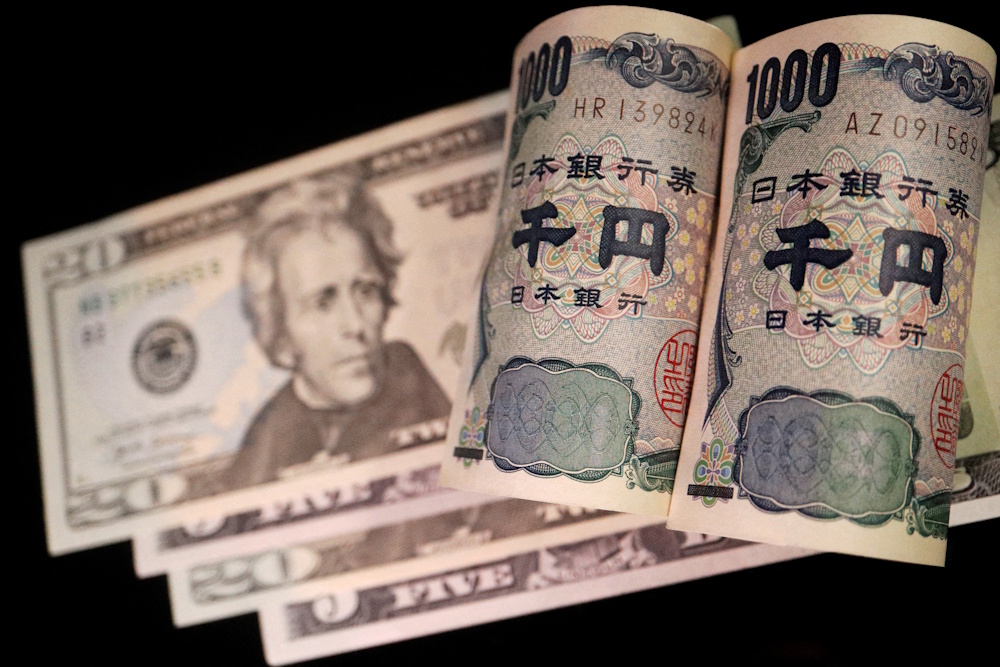
USD/JPY enters June in a standoff with the Bank of Japan, and currently, the speculators are holding the upper hand. The pair is trading around 159.50, moving upward as the yen generally lags, and it’s approaching the 160 mark that raised intervention alerts just a month prior. The scenario unfolds like a classic Western tale: the central bank has cautioned the speculators time and again to cease their upward push on the pair, yet the speculators have disregarded these warnings. Now, all eyes are on whether the bank will ultimately take decisive action or be overwhelmed by the situation. Large financial institutions are once again investing heavily in the long side of USD/JPY, wagering against a Bank of Japan that is poised to intervene to counter their positions. The tension is the trade. The war-driven dollar strength that’s impacting gold and the euro is steering dollar-yen toward 160, while the BoJ’s intervention threat and an upcoming June 16 policy meeting limit the potential for further gains. The bias remains elevated as the dollar maintains its bid; however, as the pair approaches 160, the long position becomes increasingly precarious. The price action is coiling near the highs. USD/JPY is currently positioned at approximately 159.45, reflecting an increase of about 0.12% during the session. This movement indicates that it has recovered nearly two-thirds of the value it lost following the purported intervention on April 30.
The recent trajectory illustrates the ongoing standoff: in late April, the pair surged to remarkable peaks close to 160.70 on the 30th, prompting the Bank of Japan to issue warnings and reportedly intervene. By May 6, the dollar-yen had plummeted to test the 155.00 range. Since those lows, incremental buying resumed and large players returned to the long side, pushing the pair back up through 159 and into its higher territory. Yesterday’s high reached the 159.66 level before pulling back slightly. The pair hasn’t reclaimed 160 yet in this run, but it’s close enough to necessitate a real evaluation of the forthcoming direction. The speculative range traders are observing a range that spans approximately 156.45 to 160.85, with dollar-yen positioned in the upper half, coiled and moving towards the threshold established by the central bank. The euro, the pound, and gold are all influenced by the prevailing strength of the dollar, which is currently being propelled by the Gulf region. The sequence remains consistent: U.S.-Iran strikes elevate oil prices, oil surpassing $90 contributes to inflation, the bond market adjusts to prolonged higher U.S. rates with the new hawkish Fed chair, and the interplay of increased yields alongside safe-haven demand strengthens the dollar universally. USD/JPY stands out as a highly rate-sensitive pair within the currency market. The yen, having the lowest yield among major currencies, means that any increase in U.S. yields automatically expands the gap, propelling dollar-yen higher. The war-fueled dollar bid that’s keeping EUR/USD at six-week lows is also the driving force pushing USD/JPY toward 160.
Kevin Warsh’s appointment as Fed chairman in May, interpreted as a hawkish shift, has consistently supported the dollar against all low-yielding currencies, with the yen being the lowest-yielder of them all. As long as oil remains at high levels and U.S. interest rates remain stable, the dollar component of this pair maintains an upward bias. There exists an additional mechanism that renders the yen particularly susceptible to the Iran conflict, which is linked to Japan’s trade balance. Japan relies heavily on energy imports, meaning that an increase in oil prices not only strengthens the dollar via the rate channel but also directly expands Japan’s trade deficit. This is due to the higher costs associated with each barrel of oil and cargo of LNG that the nation imports. A broader deficit results in an increased sale of yen to acquire foreign-currency energy, establishing a fundamental cause of yen weakness that exacerbates the pressures from rate differentials. The analysis clearly indicates that Brent exceeding $90 increases the deficit and establishes a support level for USD/JPY in the range of 148 to 152, which is a contributing factor to the more optimistic projections from banks. Thus, the conflict impacts the yen on two fronts: first, by bolstering the dollar due to elevated U.S. interest rates and safe-haven investments, and second, by deteriorating Japan’s external balance as a result of increased energy import costs. That double hit is the reason dollar-yen is approaching 160, despite the Bank of Japan tightening. This structural factor explains why the pair’s floor remains elevated in a high-oil environment.
The primary variable influencing the yen is the Bank of Japan’s policy meeting on June 16, and the surrounding uncertainty is what is driving the volatility in the dollar-yen exchange rate. The yen is underperforming partly due to the market’s indecision regarding a potential interest rate hike by the BoJ at that meeting. This uncertainty allows speculators the opportunity to maintain long positions as they await clarity. The broader context reveals a significant policy divergence: the Bank of Japan has been tightening its stance, departing from the ultra-loose policy that characterised its approach for decades, whereas the Federal Reserve has been easing. This narrowing rate gap is anticipated to bolster the yen in the long run. The issue at hand is timing. The rate gap is narrowing gradually, the conflict has momentarily strengthened the dollar component, and the Bank of Japan’s tightening measures have not progressed swiftly enough to counterbalance the pressures from oil and yields. A genuinely hawkish hike on June 16 could serve as the catalyst that drives dollar-yen lower toward 155; conversely, a hold or a dovish tilt would provide speculators with the green light to push through 160 and raise the question of intervention. The meeting serves as the critical juncture.
The reason 160 holds significant importance is that it represents the threshold the Ministry of Finance and the BoJ have effectively regarded as a critical boundary. The April 30 episode serves as a reference point: the pair surged to 160.70, prompting warnings from authorities and reported intervention, leading to a rapid decline in dollar-yen to 155 within a week. That memory remains vivid, serving as the upper limit on the ongoing rally. Market participants approaching the 160 level are closely monitoring the chart for indications of intervention, aware that the authorities possess both the resolve and the capability to orchestrate a significant turnaround. The speculators are wagering that the BoJ is either bluffing or limited in its actions, yet historically, every attempt to breach 160 has prompted a reaction. This is what creates an asymmetric scenario for the long USD/JPY trade near the highs — the potential upside above 160 is limited and poses risks due to the likelihood of official selling, whereas the downside risk from an intervention could lead to a decline of 400 to 500 pips within a matter of days. The nearer the pair approaches 160, the less favourable the risk/reward becomes for pursuing it, increasing the likelihood of a sharp decline.
